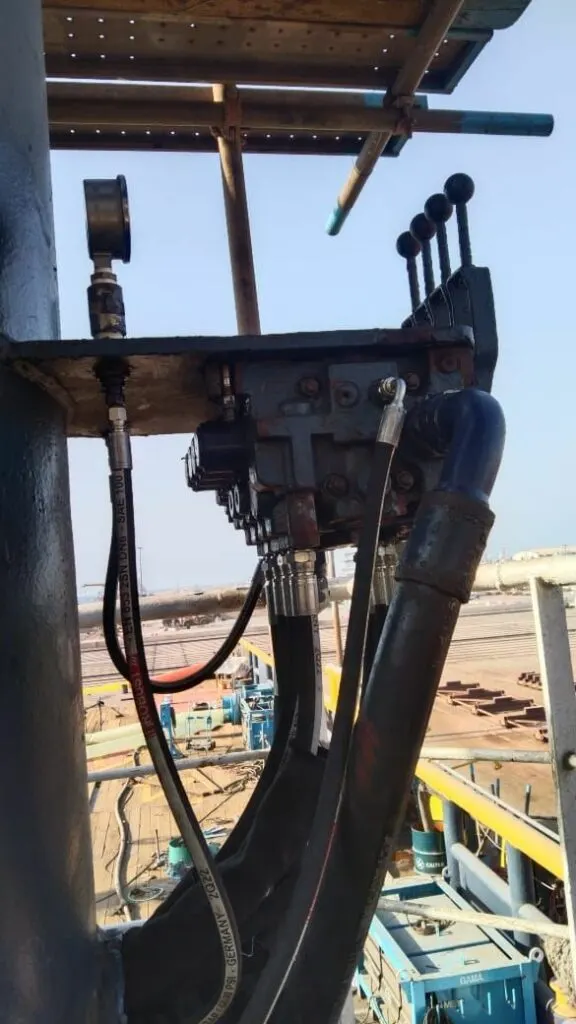
A hydraulic machine that works perfectly at 7 in the morning and drifts, slows and loses pressure by 2 in the afternoon is very often an oil temperature problem. Oil viscosity, its thickness, changes enormously with temperature, and almost everything in a hydraulic system depends on it. Move the temperature slider and watch both the chart and the oil squeezing through a valve clearance.
In simple terms
Viscosity is how easily a liquid flows. Honey is thick, water is thin. Hydraulic oil sits in between, and it changes a lot with heat: a typical oil is about ten times thicker at 20 °C than at 80 °C.
The oil has two jobs that pull in opposite directions:
- It has to be thin enough to flow easily through the pump, hoses and valves, or the pump struggles and power is wasted.
- It has to be thick enough to seal the tiny gaps inside pumps, valves and cylinders, and to keep a film between moving metal parts.
Too hot, and the oil turns thin: it slips through clearances, cylinders drift, the pump delivers less, and metal starts touching metal. Too cold, and it’s like pumping syrup: the pump can’t fill properly, the machine is sluggish and a lot of power goes into heat.
The grade (ISO VG 32, 46, 68) is the oil’s thickness at 40 °C in centistokes. A thicker grade suits machines that run hot. The viscosity index (VI) says how much the oil thins with heat: a high-VI oil changes less, so it copes better with a cold start and a hot afternoon.
Tick “Cooler failed in a Gulf summer” to see what a UAE August does to an oil chosen for a cooler climate.
The engineer's explanation, the deep dive, key numbers and the quiz open with a free account.
For engineers
Most pump makers give a viscosity window like this one. Check the actual figures for your pump.
| Condition | Viscosity | What it means |
|---|---|---|
| Optimum working range | 16 to 36 cSt | Best efficiency and life |
| Minimum, short periods | about 10 cSt | Film thin, wear and leakage high |
| Maximum, cold start | about 800 to 1,000 cSt | Above this the pump may cavitate |
| ISO VG grade | cSt at 40 °C, ±10% | VG 46 = 41.4 to 50.6 cSt |
Viscosity against temperature follows the Walther equation (ASTM D341): log log(ν + 0.7) = A − B log T, with T in kelvin. Two points (the 40 °C and 100 °C values on the data sheet) fix the line, which is why viscosity charts use double-log axes and the lines come out straight.
Internal leakage through a clearance is laminar and follows Q = π·d·h³·Δp / (12·μ·L). Two consequences matter:
- Leakage is inversely proportional to viscosity. Oil at 10 cSt leaks three times faster than oil at 30 cSt, at the same pressure and wear.
- Leakage goes with the cube of the clearance. A worn spool or pump with twice the clearance leaks eight times as much. Hot oil and wear together are what turn a “slightly tired” machine into one that won’t lift.
To choose a grade, start from the steady oil temperature you expect, not the ambient. With oil at 60 to 65 °C, VG 46 sits near 18 to 20 cSt and VG 68 near 25 to 29 cSt; both are in range, VG 68 with more margin. With oil regularly near 80 °C, even VG 68 drops towards 15 cSt, and the real fix is cooling.
Deep dive
Viscosity index. VI compares how much an oil thins between 40 and 100 °C against reference oils. Standard mineral hydraulic oils (HM) are around VI 95 to 105. HV oils, with viscosity index improvers, are 140 to 160 or more: thinner when cold, thicker when hot, so one oil covers a wider band. The catch is shear stability: the long-chain improvers can be torn by pumps and valves over time, so the “hot” viscosity falls as the oil ages. Use an HV oil with a good shear-stability rating, and check viscosity in oil analysis.
Heat makes heat. Thin oil leaks more. Leakage flow drops from high pressure to low pressure without doing any work, and all that energy becomes heat. So a system that starts to overheat tends to run away: hotter oil, more leakage, more heat. This is why an extra 10 °C matters more than it seems.
Oil life. The rule of thumb for mineral oil: above about 60 °C, every 10 °C rise roughly halves the oil’s oxidation life. Varnish, sludge and sticky valves follow. Seals harden too: nitrile seals are usually rated to about 100 °C but age much faster near their limit.
UAE conditions. With 45 to 50 °C air in summer, sun on the tank and dust on cooler fins, a power pack sized for European conditions often runs its oil at 70 to 80 °C. Check the cooler (clean fins, working fan, correct thermostat), check that the relief and any throttling aren’t wasting power, and consider a heavier grade or HV oil only after that. See hydraulic overheating in UAE heat.
Mixing oils. A 50:50 mix of two grades lands roughly at the geometric mean viscosity (VG 46 with VG 22 behaves like about VG 32). Mixing different additive types (zinc with zinc-free, or mineral with some biodegradable fluids) can cause deposits or foaming, so top up with the same product, and label the tank.
Key numbers
| Oil | at 20 °C | at 40 °C | at 60 °C | at 85 °C |
|---|---|---|---|---|
| ISO VG 32, VI 100 | about 88 cSt | 32 cSt | 15 cSt | 7 cSt |
| ISO VG 46, VI 100 | about 134 cSt | 46 cSt | 21 cSt | 10 cSt |
| ISO VG 68, VI 100 | about 210 cSt | 68 cSt | 29 cSt | 13 cSt |
| Leakage change, 30 to 10 cSt | 3 times more | |||
| Oxidation life above 60 °C | halves each 10 °C |
Work out your own figures with the oil viscosity for uae heat calculator.