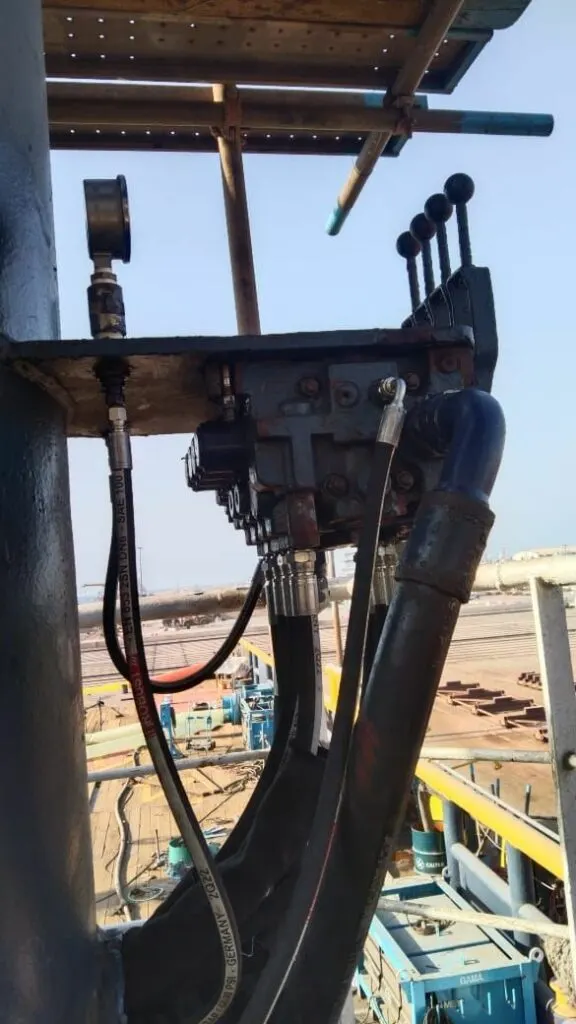
Engineers who look after hydraulic systems for long enough all say the same thing: most failures start with dirt. Not big, visible dirt, but particles of a few microns, far too small to see, that wear pumps, score valve spools and make valves stick. This lesson zooms into a valve clearance and shows what those particles do, and how a filter, a breather and a cleanliness code keep them under control.
In simple terms
Inside a pump or valve, moving parts are separated by gaps measured in microns (thousandths of a millimetre). A human hair is about 70 microns thick. The gap around a valve spool may be 5 to 15 microns.
Dirt particles that are much smaller than the gap float straight through. Particles much bigger can’t get in. The dangerous ones are those about the size of the gap: they wedge in, jam the spool, or get dragged through and scratch the metal. Scratches make the gap bigger, the valve leaks more, and the new, bigger gap lets in bigger particles. Wear feeds itself.
The filter catches particles before they reach the valves. A finer filter catches smaller ones. When an element fills with dirt, oil struggles to get through it, so a small bypass valve opens and sends the oil around it. That protects the filter from bursting, but the oil now goes round unfiltered. A clogging indicator tells you before that happens.
Most dirt comes in from outside: through the tank breather every time the oil level drops, past worn rod seals, and during repairs. In a dusty UAE yard a missing breather cap can put more dirt in a week than the system makes in a year.
The ISO 4406 code, three numbers like 18/16/13, counts particles in a sample of oil at three sizes. Each step of one number means twice as many particles. Lower is cleaner.
The engineer's explanation, the deep dive, key numbers and the quiz open with a free account.
For engineers
ISO 4406:2021 reports the number of particles per mL at or above 4, 6 and 14 µm(c) as three scale numbers. Each scale number covers a doubling of count; for example, 16 means more than 320 and up to 640 particles per mL.
Typical clearances and the cleanliness they call for:
| Component | Typical dynamic clearance | Typical target ISO 4406 |
|---|---|---|
| Servo valve | 1 to 4 µm | 16/14/11 or better |
| Proportional valve | 2 to 8 µm | 17/15/12 |
| Piston pump, high pressure | 1 to 5 µm (valve plate, slippers) | 17/15/12 |
| Directional valve spool | 5 to 15 µm | 19/17/14 |
| Gear pump | 0.5 to 5 µm (tooth tip and side plates) | 19/17/14 |
| Cylinder | 5 to 250 µm | 20/18/15 |
Use the most sensitive component on the system to set the target, then go one step cleaner for high pressure, high duty or high cost of downtime. The ISO 4406 calculator converts codes to counts.
Filter performance is the beta ratio from the multi-pass test (ISO 16889): β(x) = particles ≥ x upstream ÷ particles ≥ x downstream. Efficiency = 1 − 1/β. β = 2 is 50%, β = 75 is 98.7%, β = 200 is 99.5%, β = 1000 is 99.9%. A filter “rated 10 µm” means little without the beta value at that size.
The equilibrium cleanliness of a system is a balance between ingress and removal: roughly N = ingress ÷ (settling + filter passes × efficiency). That’s the model in the animation. It explains two things engineers see:
- Cutting ingress pays as much as finer filtering. Halve the dirt coming in and the count halves, whatever the filter.
- A bypassing filter loses almost everything. With 80% of the flow going round the element, removal falls to a fifth and the code rises by two or three numbers within days.
Deep dive
Where filters go. A suction strainer (typically 75 to 150 µm) protects the pump from large debris but must stay coarse, or the pump cavitates. A pressure filter protects sensitive valves downstream of the pump and must withstand full pressure, often without a bypass on servo systems. A return filter cleans everything coming back from the machine before it reaches the tank; it is the workhorse on most mobile and marine systems. Off-line (kidney loop) filtration runs a small pump and fine filter continuously, independent of the machine’s duty cycle, and is the most effective way to clean a large tank.
Breathers. Every litre of oil leaving the tank to fill a cylinder draws a litre of air in. A plain cap with a mesh lets fine dust through. A filtered breather (3 µm or finer) stops it; a desiccant breather also stops moisture, which matters in humid coastal sites where tank air condenses overnight.
Silting. Lots of very fine particles (below about 5 µm) settle in the gap around a spool that stays still under pressure for a long time. The spool then sticks when the operator moves it. It looks like a mechanical fault but is a cleanliness problem.
Water. Free water in oil accelerates wear, rusts steel, kills additives and encourages microbial growth. Mineral hydraulic oil holds a few hundred ppm dissolved at working temperature; more than that and it goes cloudy. On ships and in humid sites, regular water checks belong alongside the particle count.
Sampling properly. Take samples from a live, turbulent line through a proper sampling valve, with the system at working temperature, after flushing the valve. A sample from the bottom of the tank tells you about the bottom of the tank.
After repairs. New hoses, opened valves and rebuilt cylinders all bring dirt into a system. Flushing through a fine filter after work, and a sample before return to service, protects the expensive components that were not touched.
Key numbers
| What | Value |
|---|---|
| One step of an ISO 4406 number | twice the particle count |
| β = 200 | 99.5% capture at that size |
| Human hair | about 70 µm |
| Smallest particle you can see | about 40 µm |
| Typical return filter bypass setting | 2 to 3.5 bar |
| Typical breather rating for clean systems | 3 µm or finer |
Work out your own figures with the iso 4406 oil cleanliness calculator.