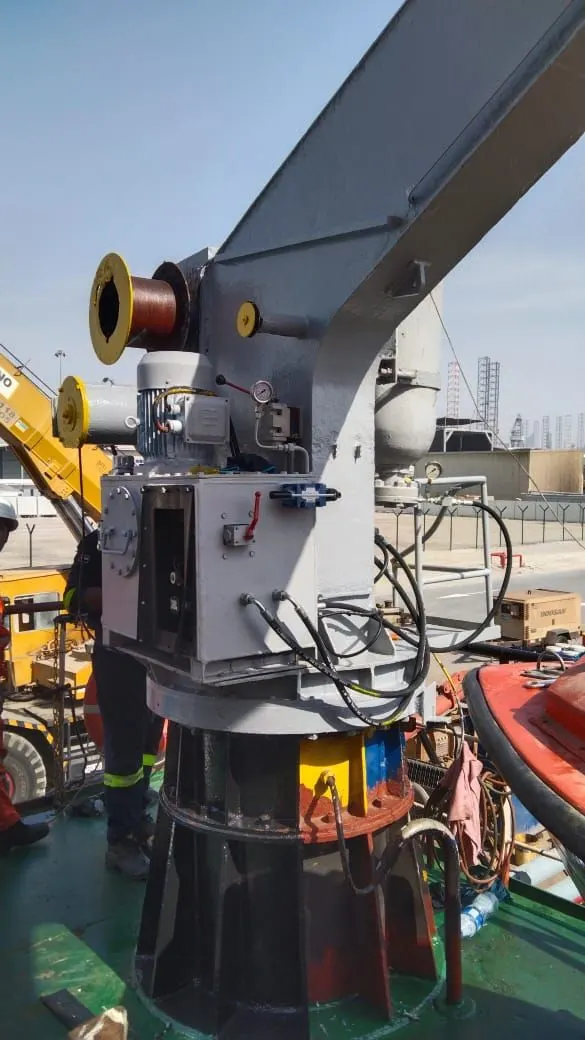
We carry out proof load tests on cranes, davits, accommodation ladders, gangways, pilot ladders, lifts and other lifting equipment across the UAE, using water bags and load cells up to 150 t, and issue a test certificate. Because we also repair hydraulics, a crane that fails its test can be fixed and re-tested by the same team.
Our load tests are regularly witnessed by class surveyors from DNV, Bureau Veritas, Lloyd’s Register and ABS. We also rent water bags and load cells to companies that run their own tests.
What we test
- Ship and offshore cranes: provision, hose-handling, deck and engine room cranes, knuckle-boom and telescopic cranes, A-frames
- Shore cranes: overhead and gantry cranes, jib cranes, truck-mounted and crawler cranes
- Lifeboat and rescue boat davits: see davit load testing
- Accommodation ladders, gangways and pilot ladder winches: see accommodation ladders and gangways
- Lifts and elevators on vessels and in industrial premises
- Bollard pull tests on tugs and OSVs, using a calibrated load cell in the tow line
- Loose lifting gear: slings, shackles, spreader beams, chain blocks and lever hoists, inspected and certified
- LMI and SLI (load moment and safe load indicators) checked and calibrated against known loads
Why water bags
Water bags are filled gradually through a flow meter while a load cell reads the actual load. That means:
- The load is applied in steps, so the crane is never shock-loaded
- The exact test load is read from the load cell, not estimated
- If something goes wrong, water can be dumped quickly to unload the crane
- On a ship or offshore, no heavy solid weights need to be delivered and lifted aboard
Bags are filled from the ship’s fire main, a hydrant or a pump, and the water is released afterwards.
Proof load for cranes
For cranes, the proof load normally follows the class/ILO table below. Davits are normally tested at 110% of SWL. Always check the requirement for your equipment with your class society or flag, because some rules and makers specify different figures.
| SWL of the crane | Proof load | Example |
|---|---|---|
| Up to 20 t | SWL + 25% | 10 t SWL → 12.5 t test |
| Over 20 t up to 50 t | SWL + 5 t | 30 t SWL → 35 t test |
| Over 50 t | SWL + 10% | 100 t SWL → 110 t test |
Our proof load calculator works this out for any SWL. With equipment up to 150 t, we cover cranes up to about 136 t SWL under the over-50-t rule.
How a load test runs
- Data. Equipment type, make, SWL, radius range and the last certificate. For cranes, the load chart.
- Quote and plan. A quote and a test plan, typically within one working day: test loads, radii, positions, who witnesses, and where water comes from.
- Pre-test inspection. Visual check of structure, hook, sheaves, wire rope and terminations, brakes, limits and hydraulics. We do not load test equipment with obvious defects. We report them first.
- Function test without load. All motions, limits and emergency stops.
- Proof load. Water bag filled in steps to the proof load, held for the required time, and the load lowered and stopped on the brake, with slewing and luffing as the procedure requires.
- Post-test examination. Checks for deformation, cracking, leakage, brake slip and cylinder drift.
- Certificate. Test certificate with the load cell reading and its calibration reference, photos and remarks.
Our guide on preparing for a crane load test lists what to have ready so the test is not delayed on the day.
What we commonly find
- Hoist brakes slipping at proof load, from worn or oil-contaminated linings
- Cylinders creeping under load because of passing piston seals or counterbalance valves. See crane hydraulics.
- Relief valves set too low so the crane cannot lift the proof load, or set too high, which hides a problem
- LMI/SLI out of calibration, cutting out too early or not at all
- Wire rope with broken wires, corrosion or deformed terminations, which must be replaced before testing
What drives the cost
The main factors in the cost of a load test are test load and the number of bags, the number of radii and positions, water supply and disposal, access (for example anchorage or offshore), the number of items in one visit, and any repair needed before the test can be passed. Several cranes or davits on one vessel in one visit cost less per item.
What to send for a fast quote
- Equipment type, make, model and SWL, with nameplate photos
- The load chart for cranes, and the last test certificate
- Location: berth, anchorage, yard or site, and the emirate
- Whether class or a third party will witness
- Your deadline, for example survey date or vessel departure
Water bag and load cell rental
We rent water bags and load cells for clients who run their own tests. Tell us the test load, location and dates. We supply bags and calibrated load cells with their certificates.