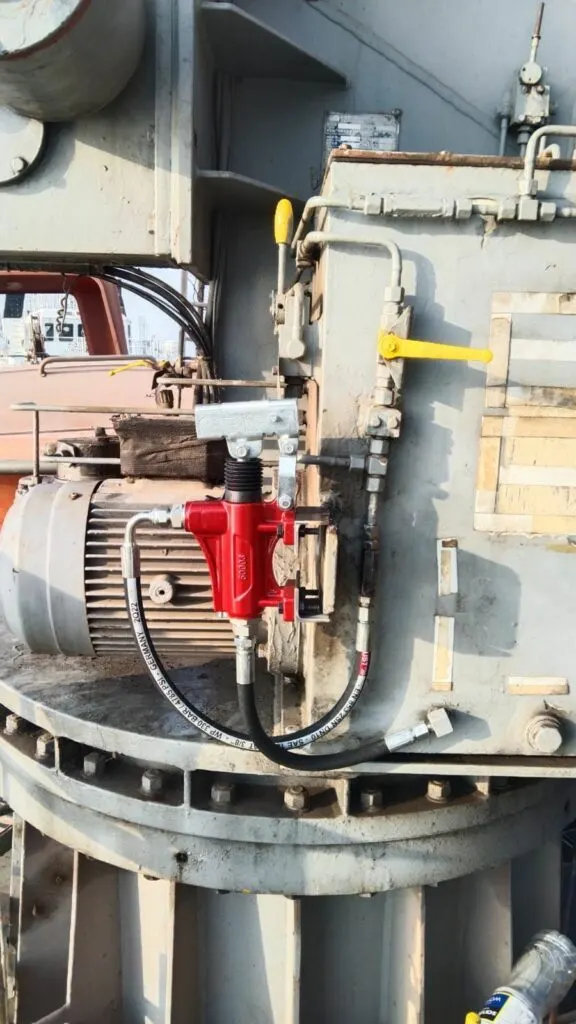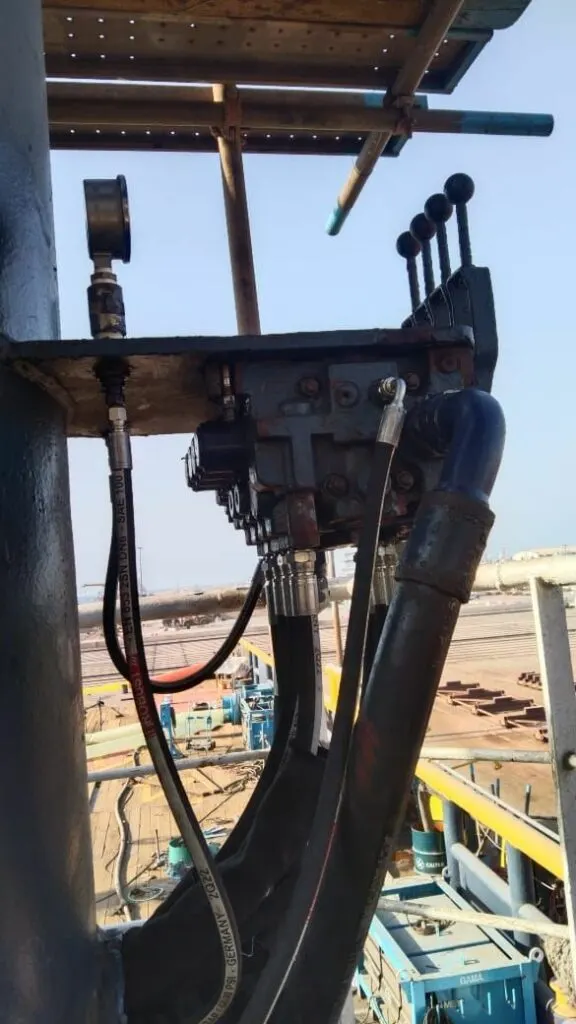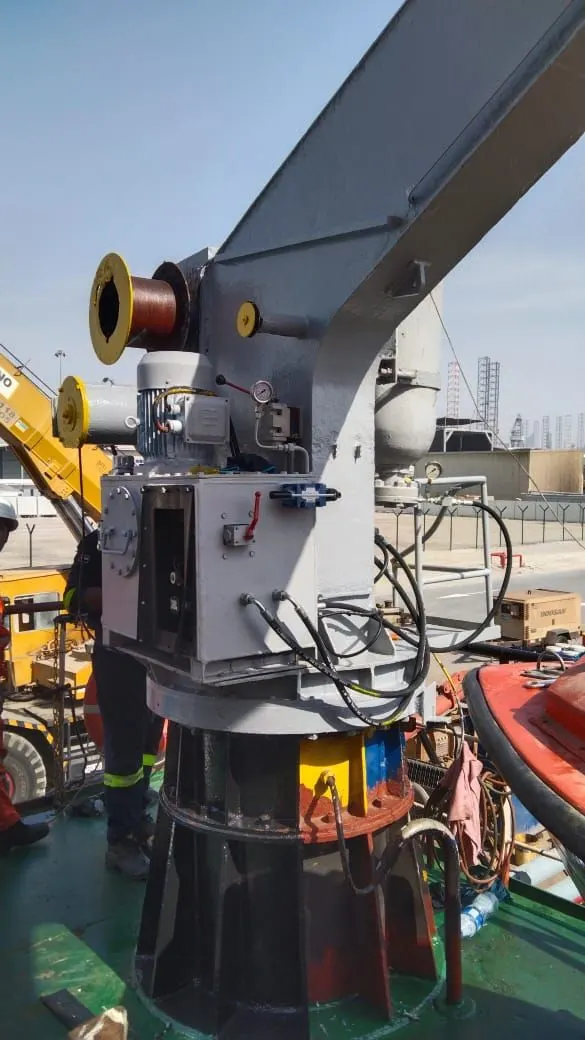
We repair and service the hydraulics of marine, offshore and land cranes across the UAE, then load test and certify them, so one team takes the crane from fault to signed-off test. Typical work is provision cranes, hose-handling cranes, knuckle-boom and telescopic cranes and A-frames, on board, in port or at the yard.
When a crane goes down, the cost is rarely the crane. It is the stores that cannot be loaded, the hoses that cannot be handled at the terminal, or the vessel waiting for a lift. We keep the fault-finding short and the paperwork complete.
Cranes we work on
- Provision and stores cranes on merchant ships, often electro-hydraulic with a pedestal-mounted power unit
- Hose-handling cranes on tankers and gas carriers
- Knuckle-boom cranes, marine and truck-mounted
- Telescopic cranes on deck and on offshore support vessels
- A-frames and stern frames on OSVs and survey vessels
- Engine room and gantry cranes with hydraulic drives
- Port and yard cranes with hydraulic slew, luff or hoist circuits
See our pages on provision and hose-handling cranes and offshore cranes and A-frames for equipment-specific detail.
What we fix
- Cylinders: luffing, folding, telescopic and outrigger cylinders, resealed or rebuilt and bench tested at 1.5 times working pressure. See cylinder repair.
- Pumps and power units: worn pumps, failed couplings, overheating, accumulator issues.
- Slewing: slewing motors, brakes and gearboxes, and slew ring play checks.
- Hoist and luffing winches: motors, brakes and brake valves.
- Control valves: valve blocks at the operator station, counterbalance and brake valves, pilot controls and solenoids.
- Hoses and pipework: full re-hosing of the crane rather than one hose at a time. See hose management.
- Safety devices: limit switches, overload protection hydraulics, and LMI/SLI calibration as part of the load test.
How a crane job runs
- Fault description and photos. The crane nameplate, the power unit and the fault: what moves, what does not, any noise, leaks or alarms.
- Quote. A quote for attendance and diagnosis, typically within one working day.
- Troubleshooting on board or on site. Pressures at test points, pilot pressures, case drain flow, oil temperature and sample, function of each motion, brake holding.
- Report and firm scope. What failed, why, and what it costs to fix.
- Repair. On site where practical, with components brought to the Sharjah workshop for overhaul.
- Function test and settings. Every motion, relief and brake setting checked and recorded.
- Load test and certificate. Proof load test with water bags and load cells, LMI/SLI check, and certificate. See load testing.
What we measure
- System and relief pressures on each function, and pilot pressures
- Counterbalance valve settings on luffing and folding circuits
- Case drain flow on pumps and motors to judge internal wear
- Oil temperature during operation, and oil cleanliness against an ISO 4406 target
- Cylinder drift under load with the control in neutral
- Slew ring rocking clearance where the maker gives a limit, and slewing brake holding
- Hoist brake holding and lowering control under test load
Common crane failures in UAE conditions
- Heat soak on deck: power units on pedestals in direct sun run hot oil, which ages seals and hoses and lets relief valves pass. See hydraulic overheating in UAE heat.
- Sand and salt on exposed rods, causing seal wear and leaking glands.
- Hose ageing from UV and heat, with cracked outer covers and weeping fittings.
- Booms creeping down from passing counterbalance valves or bypassing piston seals. See cylinder drift causes.
- Cranes left unused for long periods, then failing on first use with stuck valves and corroded electrics.
What drives the cost
Crane work spans a wide range of scope. A day of troubleshooting with a valve adjustment and a relief reset sits at the low end. A crane with several cylinders resealed, a pump overhaul, full re-hosing and a load test sits at the high end. Access, the crane’s make and parts availability, and whether the work must fit into a short port stay all affect the cost and the time on board.
What to send for a fast quote
- Crane make, model, SWL and outreach, with nameplate photos
- Photos of the power unit, valve block and the area of the fault
- What the fault is and when it started
- Vessel or site, emirate, and the time window available
- Whether a load test and certificate are needed after repair