Hydraulic systems overheat in the UAE because the heat generated inside them stays the same while the air available to cool them reaches 45 to 50 °C, so a cooler that copes in winter can lose more than half its capacity in summer. Aim to keep oil between about 40 and 60 °C. Above 60 °C oil ages faster, seals harden and leakage rises, and above about 80 °C damage builds quickly.
Most overheating can be fixed without redesigning the system: find where the heat comes from, clean and check the cooler, and set the relief and compensator valves correctly.
Why oil temperature matters
| Oil temperature | What happens |
|---|---|
| 40 to 55 °C | Good working range for most mineral oils and nitrile seals |
| 55 to 65 °C | Acceptable, but oil and seals age faster |
| 65 to 80 °C | Oxidation speeds up, viscosity falls, leakage and wear rise |
| Above 80 °C | Rapid oil breakdown, varnish, seal damage; many systems alarm or trip here |
A common rule of thumb: above about 60 °C, every 10 °C rise roughly halves the service life of the oil. Nitrile (NBR) seals harden and crack when run hot for long periods; fluorocarbon (FKM) seals tolerate more heat but cost more.
Viscosity drops sharply with heat. A VG 46 oil that is 46 cSt at 40 °C may be around 15 cSt at 70 °C. Thin oil leaks past pump and valve clearances, which makes even more heat. Use our viscosity tool to check your oil at your real temperature.
Where the heat comes from
Every watt of input power that does not do useful work becomes heat in the oil. The big sources:
- Relief valves passing oil. A fixed displacement pump pushing its full flow over the relief valve turns all that power into heat.
- Pressure-compensated pumps set badly, or a compensator set higher than the relief.
- Throttling across flow controls, proportional valves and counterbalance valves.
- Internal leakage in worn pumps, motors and cylinders.
- Undersized lines and hoses, which cause pressure drop.
- Open-centre valves at high standby pressure.
Heat power through a valve:
Heat (kW) = flow (L/min) × pressure drop (bar) ÷ 600
A pump delivering 60 L/min over a relief set at 200 bar makes 60 × 200 ÷ 600 = 20 kW of heat. That is more than many small power-pack coolers can remove even in winter.
Why coolers struggle in summer
An air-blast cooler removes heat roughly in proportion to the difference between oil temperature entering the cooler and the air temperature.
Example: a cooler sized to hold oil at 60 °C with 35 °C air works with a 25 °C difference. At 50 °C air, holding the same oil temperature leaves a 10 °C difference, about 40% of the design capacity. The oil will climb until the difference is big enough, which can mean 70 to 75 °C.
What this means:
- Size air coolers for 50 °C ambient, not a European or catalogue 35 °C.
- If you cannot fit a larger cooler, consider a water cooler using fresh-water or sea-water cooling on vessels.
- Coolers in an engine room or enclosed pump room see air even hotter than outside.
Checklist: system running hot
- Measure, don’t guess. Oil temperature at the tank and at the cooler inlet and outlet. Ambient at the cooler intake.
- Clean the cooler. Sand and dust pack air coolers in weeks. Salt and fouling block water coolers. Clean fins gently with low-pressure air or water from the clean side.
- Check the cooler fan runs, turns the right way, and the thermostat switches it on at the right temperature.
- Check the cooler bypass valve is not stuck open.
- Check relief valve settings. Is oil passing over the relief in normal running? A warm relief valve body or a hissing sound is a clue.
- Check pump compensator settings on variable pumps. The compensator should be set below the relief, typically 10 to 20 bar lower.
- Check for internal leakage: case drain flow on piston pumps and motors, bypass on cylinders.
- Check oil level. Low level means less time in the tank to shed heat.
- Check the oil grade is right for the climate.
- Check the tank is not boxed in without ventilation.
Choosing oil for UAE conditions
Many marine and plant systems in the Gulf run ISO VG 46 or VG 68. The choice depends on the maker’s viscosity range for the pump at the real working temperature, not just the grade in the manual written for a cooler climate.
- If oil regularly runs above 60 °C, a higher-viscosity grade within the maker’s range can reduce leakage, but fix the heat source first.
- A high viscosity index oil (HVI, often called HV) holds its viscosity better across the range.
- Oxidation stability matters more in hot climates. Ask for oil analysis to track acid number and oxidation.
UAE conditions that add heat
- Direct sun on tanks and pipework on deck can raise surface temperatures well above air temperature. Shade or reflective covers help.
- Enclosed rooms such as steering gear compartments and pump rooms trap heat.
- Dust clogs coolers and breathers.
- Long duty cycles: cranes working cargo all day, or piling rigs, never get a chance to cool.
When to add or upgrade cooling
Calculate the heat load: input power minus useful output, or add up the losses. As a starting rule, many open-loop systems lose 20 to 30% of input power as heat; badly set systems lose much more. Size the cooler for that load at 50 °C ambient, with a margin for fouling.
Before buying a bigger cooler, fix the waste. Turning a fixed pump that dumps over relief into an unloaded or pressure-compensated arrangement can remove most of the heat at the source.
When to call us
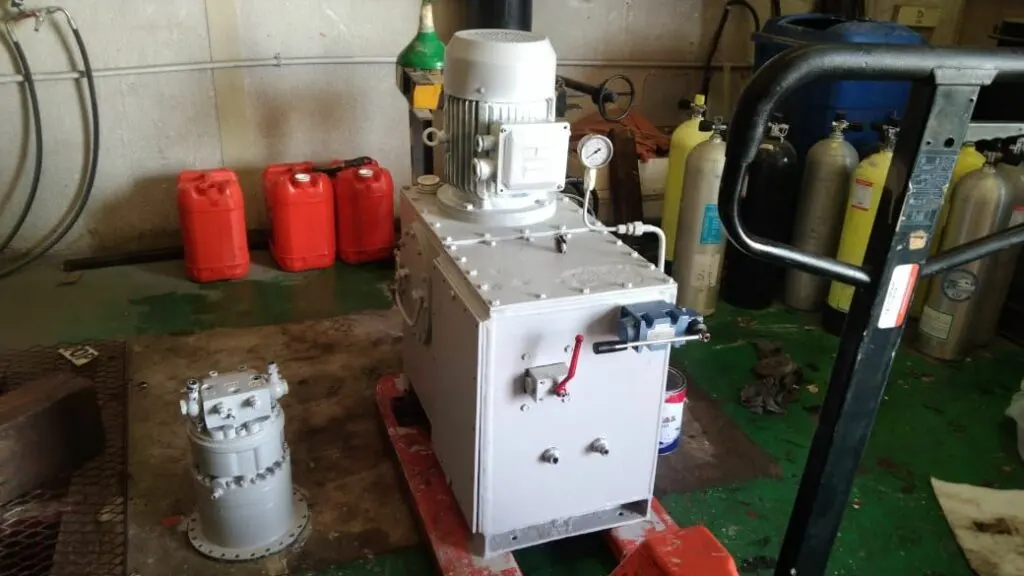
If the cooler is clean and the oil still runs hot, the cause is usually a relief or compensator setting, a worn pump or a power pack that was never sized for UAE summers. We survey the unit, measure temperatures and pressures, and recommend the fix, from resetting valves to a refurbished or new power pack. See our power pack service and industrial hydraulics service. Check your oil at real temperature with the viscosity tool, and estimate input power with the pump power calculator.