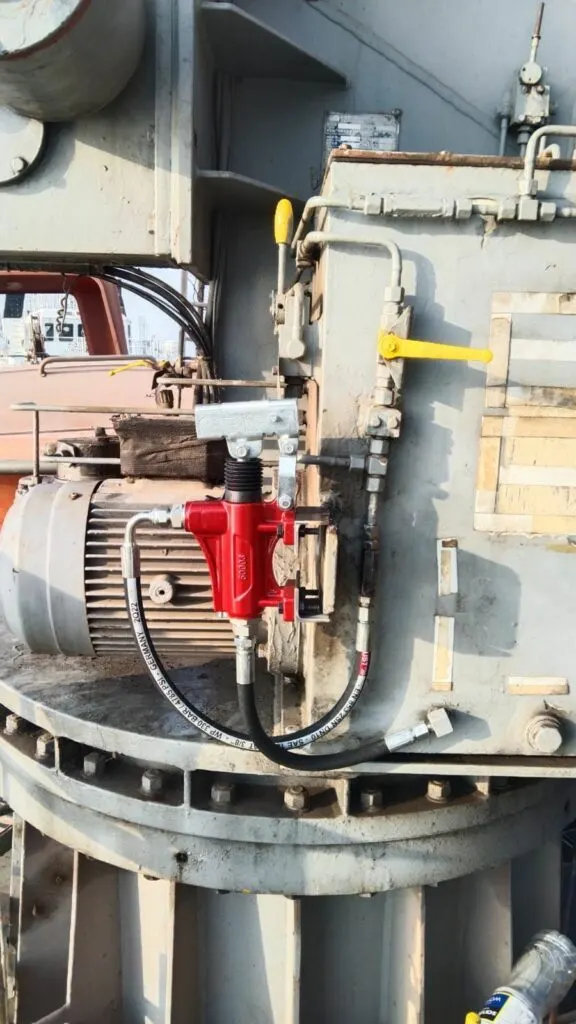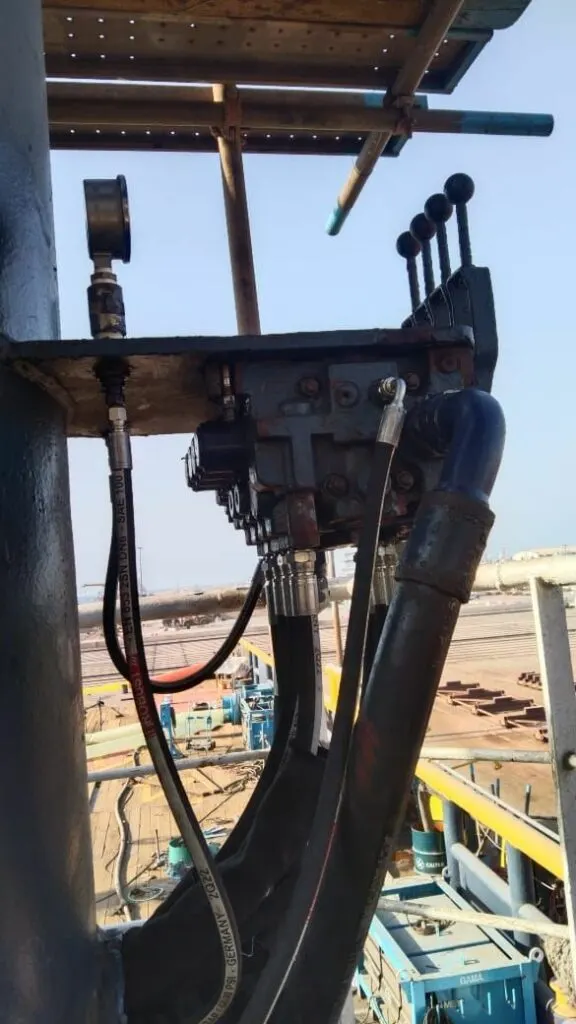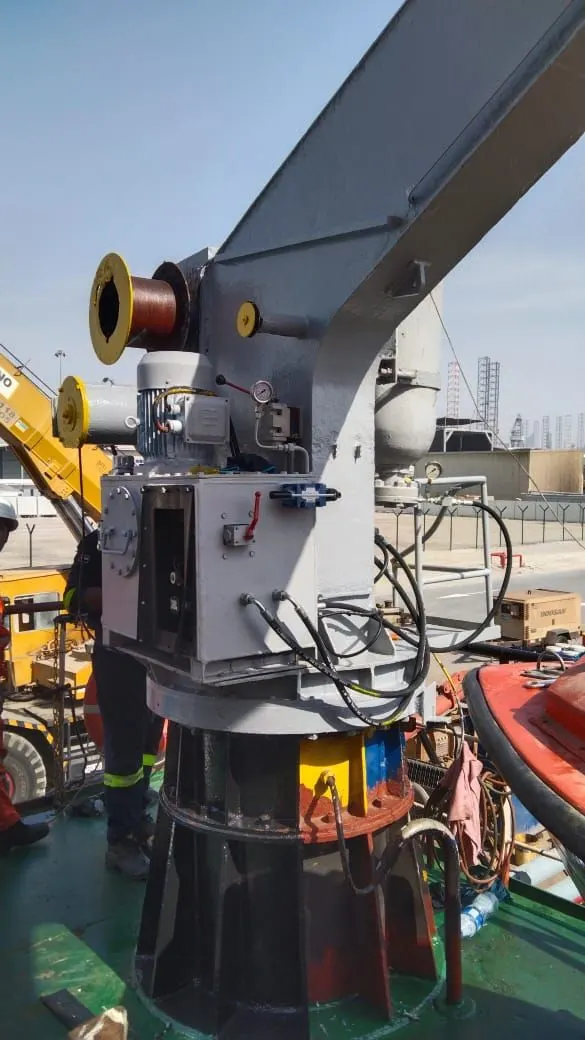
A heavy-lift crane operator in Abu Dhabi needed a 150 t MacGregor crane back in full service: one of its main pumps had to be replaced and a series of leaks fixed. Over seven days on site we installed a new pump, rectified the leaks on the pump drains, return line and main winch, and drained and filtered 7,000 litres of hydraulic oil. We also serviced the operator’s 50 t Liebherr crane during the same attendance.
The problem
The 150 t crane runs on several main pumps feeding the hoist winches. One pump had been disconnected, and the crane had leaks at pump case drains, the main return line and the main winch. With a system holding thousands of litres of oil, oil condition was also a concern: fitting a new pump into dirty oil risks an early failure.
What we found
- Pump No. 2 disconnected, with its line needing isolation before work could go ahead
- A leaking case drain hose on pump No. 4
- Two 4” butterfly valves on the main return line needing rectification
- Leaks at a flange O-ring and a 2” flange coupling O-ring on the main winch, and at the manifold block on the cabin side
- Gear and brake oil in the main and auxiliary winches due for inspection and topping up
- On the 50 t crane: two worn ½” tank-to-case-drain hoses on the main pump
What we did
150 t crane
- Isolated the disconnected line and installed the new pump No. 2
- Rectified the case drain hose on pump No. 4 and the two return line butterfly valves
- Renewed the flange O-rings on the main winch and a ½” hose in the main winch circuit
- Rectified the leaking manifold block at the main winch cabin side
- Drained the 7,000-litre hydraulic system and filtered the oil
- Inspected gear and brake oil in the main and auxiliary winches, refilled brake oil, and renewed a main winch brake casing plug
- Supplied two additional hoses for the anti-two-block protection cover
- Function tested and leak tested the crane
50 t crane
- Renewed both ½” tank-to-case-drain hoses on the main pump
- Inspected main and auxiliary winch brake and gearbox oil, and refilled brake oil
- Function tested and leak tested
Result
Both cranes were function and leak tested and handed back after seven days of attendance. The 150 t crane returned to service with all main pumps connected and its oil drained and filtered before the crane went back to work.
For cranes of this size, oil volume is a large cost. Filtering the existing oil, where its condition allows, is often far cheaper than replacing it, but it should be followed by an oil sample and particle count after a period of running.