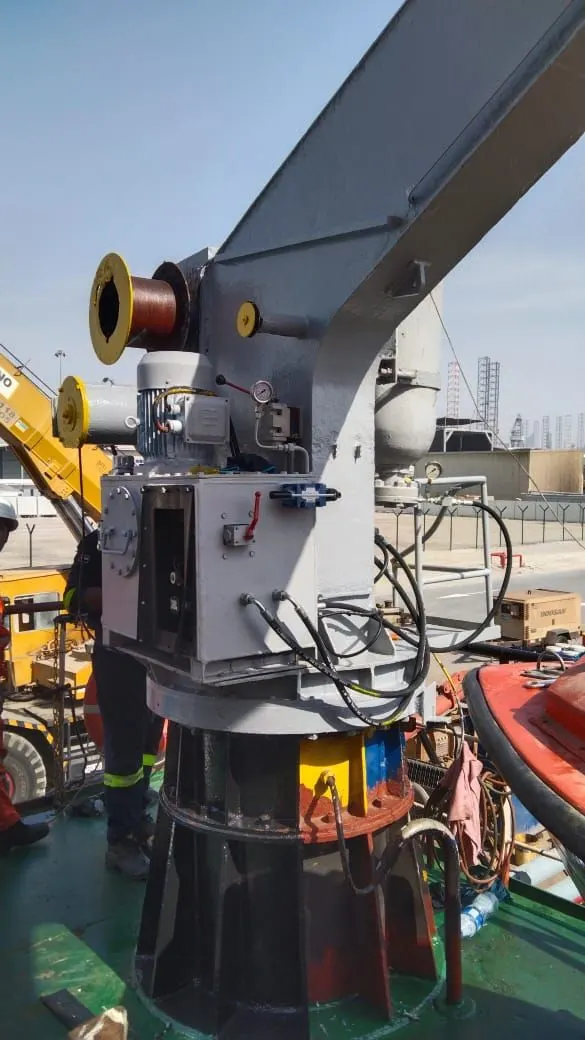
A crane load test goes smoothly when the proof load is agreed with the surveyor in advance, the water bags or weights and certified load cell are booked, there is safe space and water to fill the bags, and the crane’s hydraulics, brakes, limits and wire rope have been checked first. Most failed or abandoned tests are caused by preparation, not by the crane.
This guide is for technical superintendents, port engineers and plant managers organising a periodic or post-repair load test.
When a load test is needed
- Initial test before a crane goes into service.
- Periodic test: ship cranes are typically proof load tested at least every five years under class rules and the ILO conventions, with a thorough examination every year. Onshore cranes follow the owner’s regime, the local authority and insurer.
- After major repair or alteration, such as boom repairs, a new slewing ring, or a hoist winch change.
- When the insurer, charterer or terminal asks for a current certificate.
Proof load
For ship cranes and derricks, the usual proof load follows the class and ILO table:
| Safe working load (SWL) | Proof load |
|---|---|
| Up to 20 t | SWL + 25% |
| 20 t to 50 t | SWL + 5 t |
| Over 50 t | SWL + 10% |
So a 2 t provision crane is tested at 2.5 t, a 30 t deck crane at 35 t, and a 60 t crane at 66 t. Davits follow different rules; see our davit five-year test guide. Confirm the figure with the surveyor before the test day, especially for cranes with several SWL ratings at different radii. Our proof load calculator applies the table.
Water bags or solid weights
| Water bags | Solid test weights | |
|---|---|---|
| Transport | Light when empty, fit in a pickup | Heavy transport and a second crane to place |
| Space | Need room and a water supply | Need a strong, clear landing area |
| Load accuracy | Filled to the load cell reading | Fixed, certified masses |
| Best for | Ships, offshore, rooftops, tight sites | Yards with weights already available |
We use water bags with certified load cells for tests up to 150 t. Fresh water weighs 1 t per cubic metre; seawater about 1.025 t. A 35 t test needs about 35 m³ of water and a pump that can fill it in reasonable time, so plan the water source.
Checklist: two weeks before
- Agree the scope with the surveyor: proof load, radii, which motions (hoist, luff, slew) and whether a dynamic test is wanted.
- Gather documents: previous certificates, the crane’s load chart, the register of lifting appliances or crane logbook, wire rope certificates.
- Book the test kit: water bags sized to the load, certified load cell, shackles and slings rated above the proof load.
- Plan the space: the bag hangs over a safe area, on deck, quay or water. On vessels, check stability and deck strength with the master.
- Arrange water: fire main, shore supply or a pump from the sea for over-side tests.
- Permits: port permits, hot work if any repairs, and the terminal’s own rules.
Checklist: crane condition before the test
The crane should pass before the test weights go on. Check:
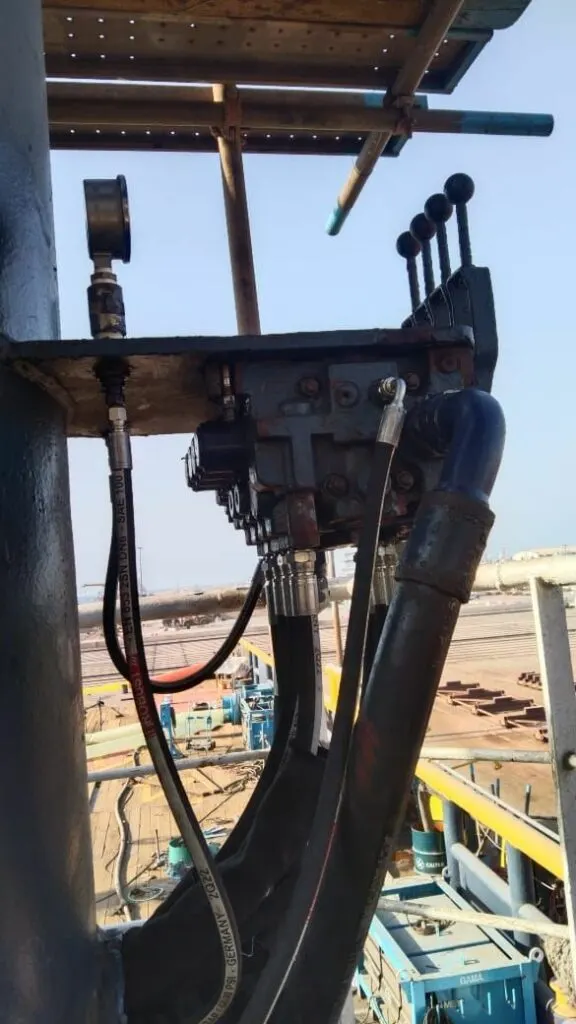
Hydraulics
- Oil level and condition. Sample if in doubt.
- Leaks at cylinders, motors, hoses and valve blocks. A weeping luffing cylinder gland may be fine at SWL and not at proof load.
- Relief valve settings. If they are set too close to working pressure, the crane may not lift the proof load. Never raise them beyond the maker’s figure to pass a test.
- Counterbalance valves and brakes hold the load without drift. See cylinder drift causes.
- Hoses: age, damage and correct routing. Replace suspect hoses first.
Mechanical
- Hoist and slew brakes: adjustment, wear, oil contamination on linings.
- Wire rope: broken wires, corrosion, kinks, crushing, and the end terminations. A rope that is near discard criteria should be renewed before the test, not after.
- Sheaves, pins and bearings.
- Hook, swivel and safety latch.
- Slewing ring bolts and bearing play.
- Structural welds. Many owners ask for crack detection on key welds and pins before a five-yearly test.
Safety devices
- Overload or load moment indicator. Calibrate or verify before testing.
- Hoist upper and lower limits, luffing limits, slew limits.
- Emergency stop.
On the test day
- Toolbox talk, exclusion zone, communication plan.
- Visual examination of the crane.
- Rig the load cell and bag. Fill in stages, checking the load cell at each stage.
- Lift the proof load clear and hold. The hold time is set by the surveyor; a few minutes is common, and the load must not drift.
- Where required, slew and luff with the load at slow speed.
- Lower, release, and examine the crane again for deformation, leaks or damage.
- Record readings, then function test the safety devices at SWL.
- Certificates and report.
Why tests fail
- Relief valve stops the lift short of proof load
- Brake slips or the load drifts
- Overload device trips or reads wrong
- Hydraulic leak appears under load
- Wire rope found in poor condition during examination
- Not enough water, pump too slow, weather or daylight runs out
Most of these are avoided with a pre-test inspection a week earlier, with time to fix what it finds.
UAE factors
- Heat: schedule outdoor tests early in the day in summer. Hot oil makes drift and leaks more likely.
- Wind: a large bag swings in a shamal. Plan for calm periods.
- Daylight: at anchorages, launches stop at dusk. Allow margin.
When to call us
If you need a crane tested, send the crane type, SWL and radius, location and target date. We can do the pre-test hydraulic inspection, any repairs and the load test with our own water bags and load cells as one job. See our load testing service and crane hydraulics service, and use the proof load calculator.