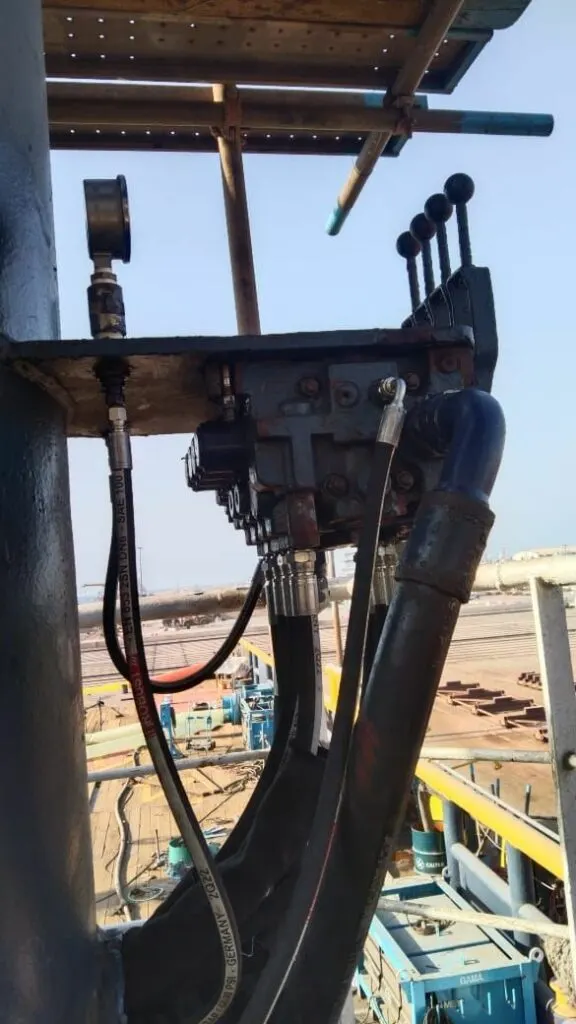
A vessel operator in the oil and gas sector asked us to stop persistent oil leaks in its valve remote control system. We put a team of four on board for up to 13 days, renewed leaking tubing runs and resealed actuators, then overhauled the system’s hand pump.
The problem
A VRCS opens and closes cargo and ballast valves from a central console through small-bore hydraulic tubing and actuators fitted on each valve. When the tubing and fittings leak, the system loses oil, valves respond slowly or not at all, and the crew fall back on manual operation. This system had leaks at multiple points along its tubing network, some in spaces that needed scaffolding to reach.
What we found
The leaks were in two places:
- Tubing and compression fittings on the 14 mm lines, where joints and runs had deteriorated over years in a hot, damp environment.
- Valve actuators of several sizes, where seals had worn.
Patching single joints would not have lasted. The practical fix was to renew the worst runs completely and reseal the leaking actuators in one campaign.
What we did
- Mobilised two hydraulic engineers and two technicians. The lead engineer was on board for 13 days, the second for 10, and both technicians for 8, with overtime to fit the vessel’s schedule.
- Supplied and fitted new 14 × 1.5 mm steel tube: twenty 6 m lengths, with 250 heavy-series unions with nuts and ferrules, plus 10 mm precision tube and unions for smaller lines.
- Arranged scaffolding where the runs could not be reached safely from deck.
- Resealed actuators using small, medium and large seal kits.
- Removed, stripped, resealed and refitted the VRCS hand pump, which the crew rely on when the power pack is unavailable.
- Kept two technician days on workshop standby for parts and tube preparation.
Result
The leaking tubing runs were renewed, the actuators were resealed and the hand pump was returned to service within one campaign of about two weeks. The operator received a single invoice covering attendance, materials and scaffolding, based on the actual days our people spent on board.
Leak campaigns like this go further when the oil is cleaned too. Fine dirt in VRCS oil damages actuator seals and small valves, so we recommend a particle count after any major VRCS repair.