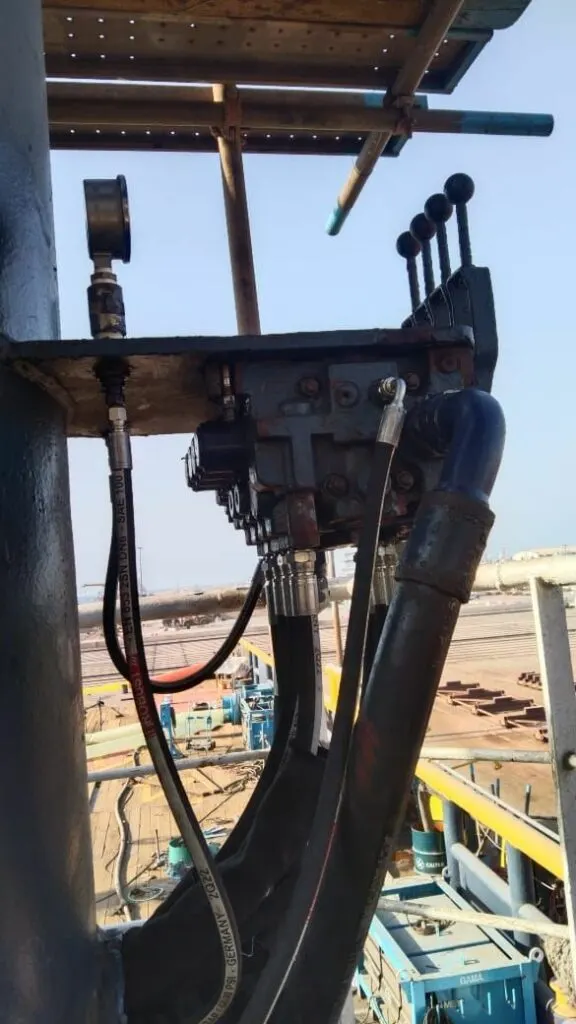
A healthy hydraulic pump hums. A pump that rattles like it is full of gravel, or whines and turns the oil milky, is telling you that something is wrong on its suction side, not usually inside the pump itself. The two classic causes, cavitation and aeration, sound similar and feel similar, but they come from opposite directions. Play with the suction line above and you will see why.
In simple terms
A pump doesn’t really suck oil. It makes a space, and the air pressure pushing down on the oil in the tank pushes oil into that space. That push is only about 1 bar, and everything between the tank and the pump uses some of it up: lifting the oil if the pump sits above the tank, dragging it through a long or thin pipe, forcing it through a strainer, and speeding it up into the pump.
Cavitation happens when too little of that push is left. The pressure at the pump inlet drops so low that bubbles form in the oil, from dissolved air and oil vapour. A moment later the pump carries those bubbles into the high-pressure side, where they are crushed and collapse. Each collapse is a tiny hammer blow against the metal. Thousands of them a second make the gravel rattle and pit the pump’s surfaces.
Common causes: a blocked strainer, a suction line that is too thin or too long, cold thick oil, a pump running too fast, or a pump mounted above the oil.
Aeration is air getting into the oil from outside. The suction line is below atmospheric pressure, so a loose fitting or a cracked hose there doesn’t leak oil, it sucks air in. You won’t see a drip. Air also gets in when a return line ends above the oil surface and splashes. The bubbles go round the circuit, the oil turns milky and foams, the pump whines, and cylinders move in jerks because air squashes.
The engineer's explanation, the deep dive, key numbers and the quiz open with a free account.
For engineers
Absolute pressure at the pump inlet:
p(inlet) = p(atm) + ρ g h − Δp(line) − Δp(strainer) − (1 + K) ρ v² / 2
- p(atm) is about 1.013 bar at sea level.
- ρ g h is the oil column: about 0.085 bar per metre for mineral oil. Negative if the pump is above the oil.
- Δp(line) = f (L / d) ρ v² / 2, with f = 64 / Re in laminar flow (most suction lines) and Re = v d / ν.
- The velocity head and entry loss: the animation uses 1.5 × ρ v² / 2.
| Case | Inlet pressure |
|---|---|
| 50 mm line, 1.2 m, oil at 40 °C, 0.3 m head, 67.5 L/min | about 1.01 bar abs |
| Same, strainer badly clogged | about 0.53 bar abs: cavitating |
| 25 mm line, 2 m | about 0.89 bar abs: close to the limit |
| 50 mm line, oil at 5 °C (about 380 cSt) | about 0.84 bar abs |
Inlet limits. Most gear and vane pumps need at least 0.8 bar absolute at the inlet (a vacuum of about 0.2 bar). Many piston pumps need 0.8 to 1.0 bar absolute or a flooded inlet, and some need boost pressure. Check the manufacturer’s figure; it often depends on speed and viscosity.
Suction line sizing. Aim for 0.5 to 1.2 m/s in suction lines, against 3 to 6 m/s in pressure lines. Keep them short, straight and without restrictions. A suction strainer should be sized well above pump flow, at the viscosity of cold oil, and many systems now use a return filter and a coarse suction strainer, or none, for this reason.
Telling them apart:
| Clue | Cavitation | Aeration |
|---|---|---|
| Sound | Rattle, like gravel | Whine or erratic noise |
| Oil in the tank | Clear | Milky, foam on the surface |
| Inlet vacuum gauge | High vacuum | Normal or low vacuum |
| Worse when | Oil cold, speed high, strainer dirty | Oil level low, after hose work |
| Pump damage | Pitting on the high-pressure side of the port plate or gears | Erosion, overheating, poor lubrication |
Deep dive
Why bubbles collapse so violently. When a vapour bubble moves into oil at 200 bar, it can’t hold its shape: it collapses inwards in microseconds. The collapse produces a jet and a pressure spike of hundreds or thousands of bar right at the metal surface. Repeated millions of times, that pits valve plates, gear side plates and port edges in a characteristic frosted pattern, and the debris then wears everything downstream.
Gaseous versus vapour cavitation. Mineral oil holds about 7 to 9% air by volume dissolved at atmospheric pressure. As pressure falls, that air comes out of solution first, well before the oil itself boils. That is why the practical limit is 0.8 bar absolute rather than the oil’s true vapour pressure, which is far lower. Air that comes out of solution doesn’t redissolve instantly, so it also causes aeration downstream.
Cold starts. ISO VG 46 oil is about 46 cSt at 40 °C but nearly 400 cSt at 5 °C and over 550 cSt at 0 °C. Line and strainer losses rise in proportion. Even in the UAE, early winter mornings and air-conditioned engine rooms see machines started cold and run hard immediately. Warming up at low speed for a few minutes protects the pump.
Aeration sources to check: suction hose clamps and flange O-rings, the pump shaft seal (on pumps with an inlet-side seal), return lines above oil level, a tank with no baffle between return and suction, an oil level so low that the suction pipe draws a vortex, and air left after maintenance. Pour a little oil over a suspect suction joint while the pump runs: if the noise changes, that joint is drawing air.
Mounting. A pump mounted below the tank’s minimum oil level (a flooded inlet) is the most reliable layout. Where a pump has to sit above the tank, keep the lift short, use a generous line and check the inlet vacuum with a gauge during commissioning and at every service.
Key numbers
| What | Typical value |
|---|---|
| Atmospheric push available | about 1 bar |
| Minimum inlet, gear and vane pumps | about 0.8 bar absolute |
| Oil column | about 0.085 bar per metre |
| Suction line velocity | 0.5 to 1.2 m/s |
| Air dissolved in mineral oil at 1 bar | about 7 to 9% by volume |
| ISO VG 46 viscosity at 0 / 40 / 80 °C | about 580 / 46 / 11 cSt |