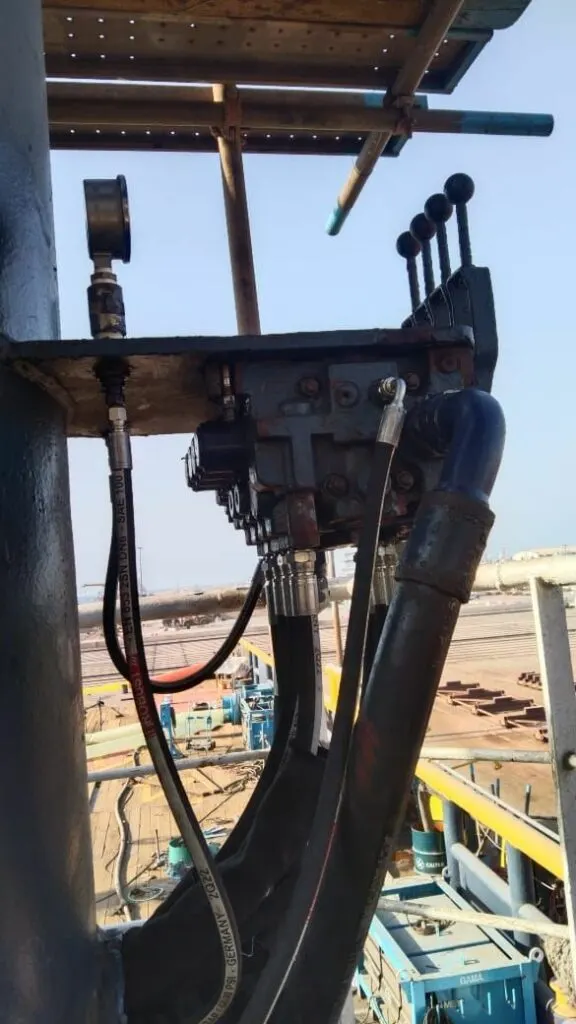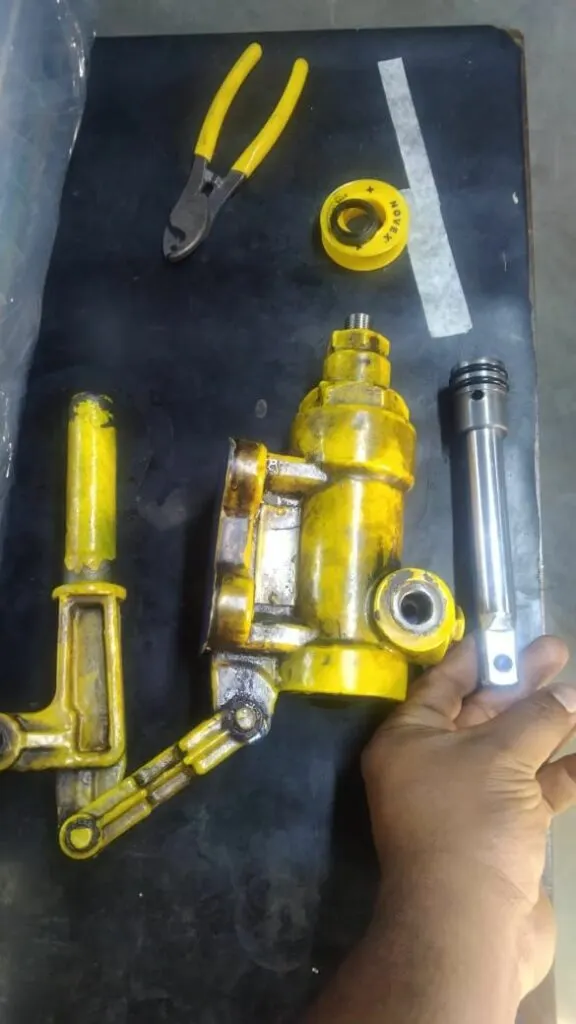
A hydraulic pump that has become noisy is usually telling you one of three things: it cannot get enough oil on the suction side (cavitation), air is getting into the oil (aeration), or something mechanical is wearing out, such as the coupling, bearings or rotating group. Each sounds different and has a different fix, and most can be found with a few checks before the pump is removed.
Ignoring the noise is expensive. Cavitation and aeration erode pump parts quickly, and a pump that breaks up sends debris through the whole system.
What the sound tells you
| Sound | Likely cause | First checks |
|---|---|---|
| Steady high-pitched whine, rises with speed | Cavitation: suction starved | Oil level, suction strainer, suction valve open, oil viscosity |
| Irregular crackling, like gravel, foamy oil | Aeration: air drawn in | Suction joints, shaft seal, return lines above oil level, oil level |
| Knocking or rumble at shaft speed | Coupling or bearing wear, misalignment | Coupling spider, alignment, bearing play |
| Squeal at start-up | Belt or coupling slip, very thick oil | Coupling, oil temperature |
| Noise only at high pressure | Relief valve chatter, worn pump compensator | Relief valve, compensator setting |
| Noise that started after a repair | Air not bled, wrong rotation, wrong suction hose | Bleed, rotation arrow, hose spec |
Cavitation
Cavitation happens when pressure at the pump inlet falls so low that vapour bubbles form in the oil and then collapse violently inside the pump. It pits the valve plate, port plate or gears.
Common causes:
- Blocked suction strainer or filter, often forgotten because it sits inside the tank
- Suction ball valve partly closed after maintenance
- Suction hose collapsed internally or too small
- Oil level too low, so the inlet is close to the surface
- Oil too thick for the starting temperature (less common in the UAE, but possible with VG 68 or higher in an air-conditioned engine room)
- Pump running faster than its rated self-priming speed
- Tank too far below the pump
Piston pumps are the most sensitive. Many need an inlet pressure close to atmospheric or above; check the maker’s data sheet for the minimum inlet pressure. A vacuum gauge at the inlet is the quickest test.
Aeration
Aeration is air entering the oil. It makes the oil cloudy or foamy, the noise is irregular, and actuators feel spongy.
Common causes:
- Loose suction fitting or a cracked suction pipe drawing air
- Worn pump shaft seal on a suction-side seal design
- Return lines ending above the oil level, splashing air into the tank
- Low oil level with a vortex at the suction
- Tank too small, so oil has no time to release air before returning to the pump
A simple test: pour oil over each suction joint while the pump runs. If the noise changes, you have found the leak.
Mechanical wear
Many pumps we see in the UAE are noisy because of the drive, not the pump.
- Coupling spider (elastomer insert): these harden and break up with heat. A broken spider gives a knocking noise and eventually destroys the coupling halves. It is one of the most common parts we renew on power packs, often on several units at once.
- Misalignment between motor and pump overloads bearings and shaft seals.
- Bearing wear in the pump or electric motor gives a rumble that rises with load.
- Rotating group wear in piston pumps: worn slippers, swash plate or valve plate. This usually also shows as lower flow and higher case drain flow.
The case drain flow test (piston pumps and motors)
Piston pumps and motors leak a small amount of oil internally, which leaves by the case drain. As they wear, that leakage rises.
- With the system at normal operating temperature, run the pump at a steady pressure.
- Disconnect the case drain line into a measuring container, or fit a flow meter.
- Measure the flow in litres per minute.
- Compare with the maker’s figure or with readings from when the pump was new.
As a rough rule, case drain flow climbing well beyond a few percent of rated flow means significant internal wear. Track the trend rather than relying on one reading.
Step-by-step diagnosis
- Check oil level and look at the oil. Foam or milkiness → aeration or water.
- Check the oil temperature. Above 60 °C everything gets noisier and wears faster; see overheating.
- Confirm all suction valves are fully open.
- Fit a vacuum gauge at the pump inlet. Too much vacuum → suction restriction → strainer, hose, valve.
- Pour-test suction joints for air leaks.
- Stop the unit, isolate, and check the coupling spider and alignment.
- Check pressure and relief valve behaviour. Chatter at the relief → valve.
- Do a case drain flow test on piston pumps.
- If all of that is clean, plan a bench overhaul of the pump.
When to overhaul
Overhaul the pump when:
- Case drain flow is high or rising quickly
- Flow at rated speed and pressure is well below spec, so actuators are slow
- The pump has been cavitating or aerating for a long time
- There is metal in the filters or the oil sample
A pump overhaul covers strip-down, inspection of the rotating group, valve plate, bearings and seals, renewal of worn parts, and testing. Brands we regularly see include Bosch Rexroth, Parker and Denison, Danfoss, Kawasaki, Hydac, Staffa and Brevini.
After a pump failure
If the pump broke up, debris has gone downstream. Before fitting a new or overhauled pump:
- Change all filters
- Clean the tank and suction strainer
- Flush or drain and refill the oil
- Check valves and motors downstream for damage
- Take an oil sample after a few running hours
Skipping these steps is the most common reason a new pump fails within weeks.
When to call us
If the cause is not in the suction line or the coupling, the pump probably needs a bench overhaul. Send the make, model and nameplate photo, and describe the noise, pressures and any case drain readings. See our pumps and motors service and check motor and pump sizing with the pump power calculator.