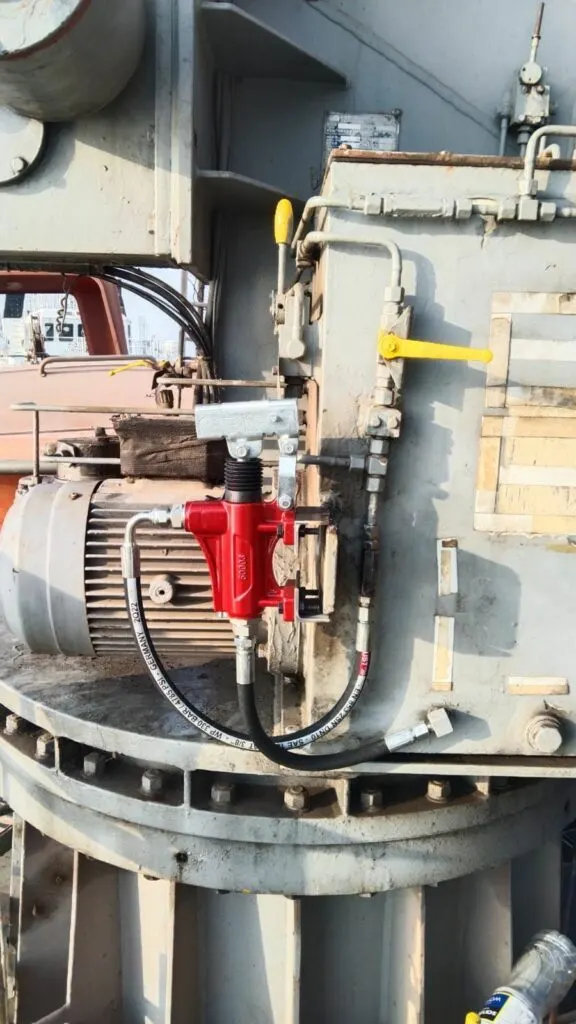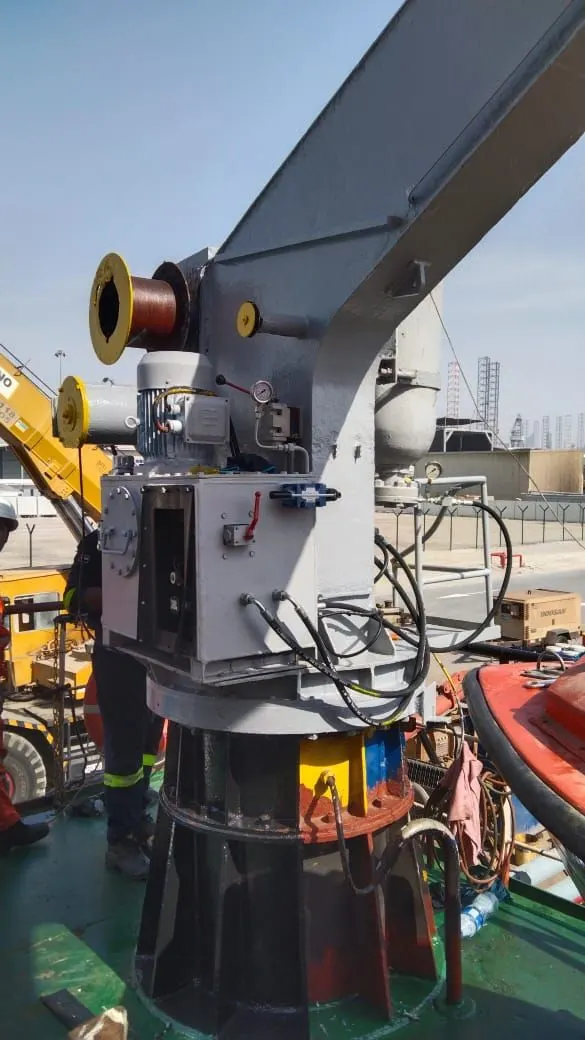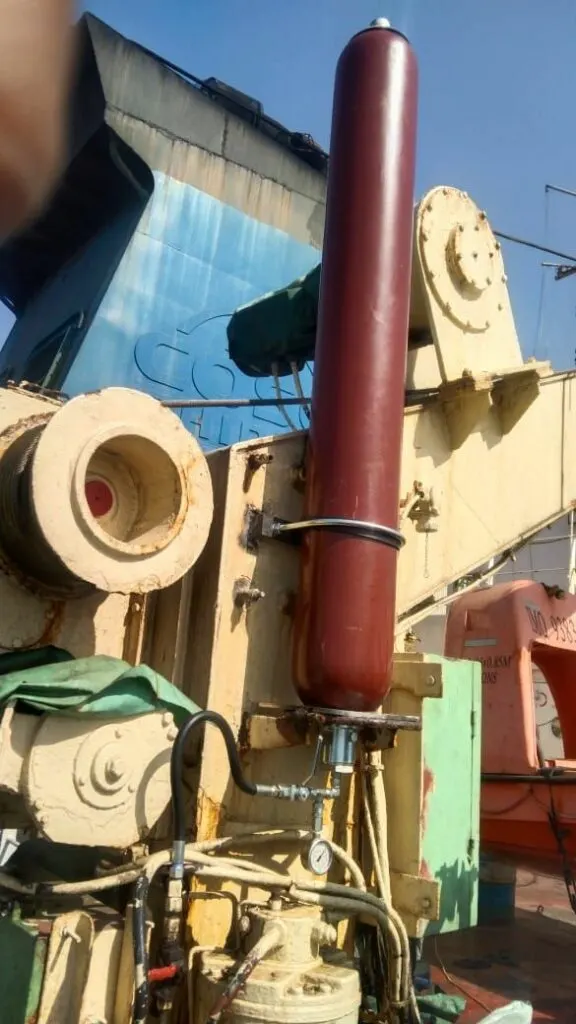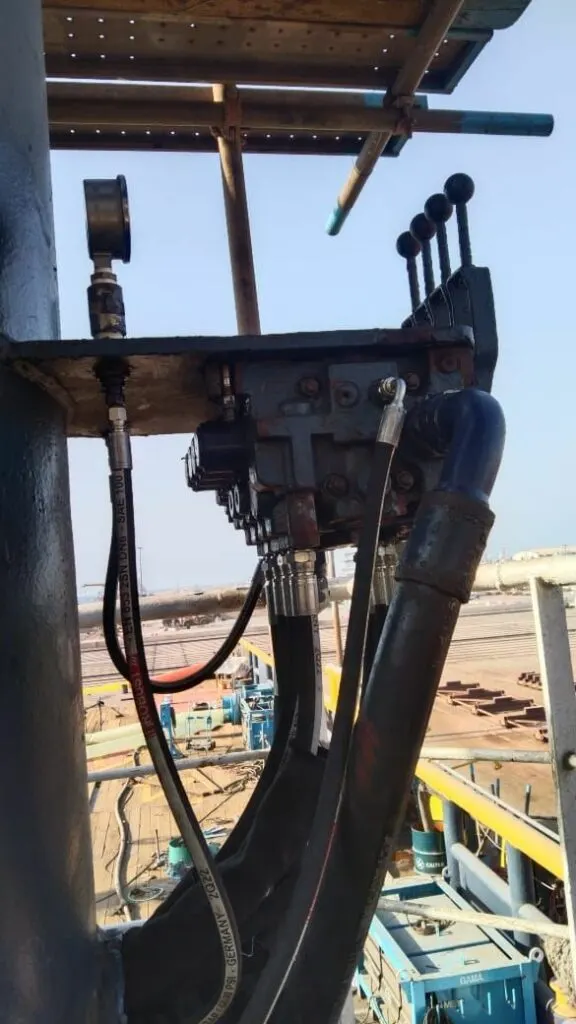
We repair and load test the provision cranes and hose-handling cranes found on almost every merchant ship, and especially on tankers, where the hose-handling crane must work every time the ship connects to a terminal or bunker barge. Most of this work is done during port calls in the UAE or at the Fujairah and Khor Fakkan anchorages.
What these cranes are
Provision cranes lift stores, spares and provisions aboard, typically with an SWL of a few tonnes. They are usually electro-hydraulic stiff-boom, telescopic or knuckle-boom cranes mounted on the accommodation side.
Hose-handling cranes on tankers and gas carriers lift cargo and bunker hoses to and from the manifold. They are larger, often around 10 to 15 t SWL on many tankers, and must reach the manifold on both sides of the ship. Because cargo operations stop without them, a hose-handling crane fault becomes an urgent problem.
How the hydraulics work
Most of these cranes have a self-contained electro-hydraulic power unit in the pedestal or the crane house: an electric motor drives one or more pumps, feeding a control valve block. From there:
- Luffing cylinder(s) raise and lower the boom, held by counterbalance or load-holding valves.
- Slewing is driven by a hydraulic motor and a slewing gearbox onto a slew ring, with a brake.
- Hoist winch is driven by a hydraulic motor with a brake and often a counterbalance valve.
- Telescopic or knuckle cylinders on those crane types.
- Limit switches, an overload or SLI system and an emergency stop circuit.
Typical faults
- Boom creeping down under load, from a leaking counterbalance valve or worn piston seals in the luffing cylinder. See cylinder drift causes.
- Slow or weak hoisting from a worn pump, a sticking relief valve or a worn hoist motor.
- Jerky slewing or slewing that will not hold, from slewing motor wear, brake problems or valve faults.
- External leaks at cylinder glands and from hoses, which on a tanker deck are a pollution and safety finding in inspections.
- Overheating of the power unit in summer, especially when the cooler is fouled. See hydraulic overheating in UAE heat.
- Electrical faults that look hydraulic, such as solenoids, limit switches or the overload system tripping.
- Wire rope wear, which is both an inspection finding and a reason the crane may fail its load test.
Tests and documentation
Ship cranes are thoroughly examined and load tested at intervals set by flag, class and the ILO conventions on cargo gear, usually an annual thorough examination and a proof load test every five years and after major repairs. Charterers and oil major inspections check the crane’s certificates and condition on tankers.
Proof loads for cranes follow the class and ILO table:
| SWL | Proof load |
|---|---|
| Up to 20 t | SWL + 25% |
| 20 to 50 t | SWL + 5 t |
| Over 50 t | SWL + 10% |
We carry out proof load tests with water bags and calibrated load cells up to 150 t, check limit switches and the SLI, and report the results with photographs. Our tests are regularly witnessed by class surveyors from DNV, Bureau Veritas, Lloyd’s Register and ABS. Use our proof load calculator to check the test load. See also preparing for a crane load test.
What we do
- Troubleshoot on board with gauges: system pressure, relief settings, pilot pressures and component behaviour, so parts are only replaced when they are the cause.
- Repair on board where possible: seal renewals, valve overhauls, accumulator checks and hose replacement.
- Bench work in our Sharjah workshop for luffing cylinders, pumps and motors, with a bench pressure test at 1.5 times working pressure for cylinders.
- Re-hose the crane from a hose survey, with hoses made up in our workshop, usually within one or two days. See hose management.
- Renew the wire rope with certificates.
- Load test and issue the report.
See crane hydraulics for our full crane scope.
What to send for a quote
- Vessel name, port or anchorage and ETA.
- Crane maker, model and SWL, with a photograph of the nameplate.
- The fault and any alarm messages.
- Photographs of leaks and of the power unit.
- For load tests: last test certificate and the class society.
We usually quote within one working day of receiving photos and nameplate data. We focus on overhauls, load tests and planned work rather than single-hose call-outs; for one hose, a local hose shop will be quicker.