Every five years, lifeboat and rescue boat launching appliances must have a thorough examination and an operational test of the winch brake with a test load of 1.1 times the total mass of the boat with its full complement and equipment, under the SOLAS chapter III requirements and the servicing rules in IMO resolution MSC.402(96). On-load release gear must also be overhauled and tested in the same five-yearly cycle. The test is usually done with water bags or test weights and a certified load cell, and is witnessed by the flag or class surveyor where required.
The annual thorough examination happens in the years between. This guide explains what the five-yearly test involves, how to prepare, and why tests fail.
The rules in short
- SOLAS chapter III, regulation 20 sets the requirements for maintenance, thorough examination, operational testing, overhaul and repair of lifeboats, rescue boats, launching appliances and release gear.
- MSC.402(96), mandatory since 1 January 2020, sets out how that servicing is done and by whom. It requires that servicing is carried out by the manufacturer or by a service provider authorised by the Administration (the flag state), with personnel certified for the work.
- The LSA Code sets the design and testing standards for life-saving appliances, including the factory and installation tests for davits and winches.
- Fall wires must be turned end for end at intervals of not more than 30 months and renewed when necessary due to deterioration or at intervals of not more than 5 years, whichever is earlier.
Your flag state may have additional instructions, and the davit maker’s manual gives the detailed procedure for each model. Always check both.
Annual versus five-yearly
| Item | Annual | Five-yearly |
|---|---|---|
| Thorough examination of davit structure, winch, falls, sheaves | Yes | Yes |
| Winch brake examination | Yes | Yes, including opening up as the maker requires |
| Dynamic winch brake test | Empty boat or test as specified | With 1.1 × boat, full complement and equipment |
| On-load release gear | Examination and operational test | Overhaul and operational test under load |
| Fall wires | Examination; turn end for end at 30 months | Renew at 5 years at the latest |
What happens during a five-yearly test
- Document review. Maintenance records, previous certificates, the maker’s manual and the boat’s mass data.
- Thorough examination of the davit arms, pins, sheaves, structure, winch, gears, brakes (main and centrifugal), limit switches and falls.
- Release gear overhaul and examination of hooks, cables and the release mechanism.
- Test load preparation. The test load is 1.1 times the mass of the boat with full complement and equipment. Water bags are placed in the boat, or the boat is replaced by bags, and filled to the load cell reading.
- Dynamic winch brake test. The loaded boat is lowered at normal speed and the brake applied. The stopping distance and brake behaviour are checked against the maker’s limits.
- Release test. The on-load release gear is operated under load as required.
- Recovery and re-examination of the davit and winch.
- Reports and certificates issued by the service provider.
Some davit makers and flags also call for a static brake test at a higher load. Follow the maker’s manual and flag instructions; the test plan should be agreed before the day.
Working out the test load
Test load = 1.1 × (lightship mass of the boat + equipment + persons at the assumed mass per person)
The boat’s certificate or manual gives the mass with full complement. Use the stated figure, not an estimate. For rescue boat davits that also act as cranes, other test loads may apply; check the maker’s data.
Our proof load calculator handles the 1.1 davit factor and the crane table.
Preparing the vessel
- Calm water and daylight. Launching tests at anchorage stop at dusk.
- Space and permission. The boat is lowered to the water or to a safe height. Port permission is usually needed for launching.
- Water supply for the bags.
- Crew and communication. A competent crew to operate the davit and radios.
- Power for electric or hydraulic davits, and emergency stop tested.
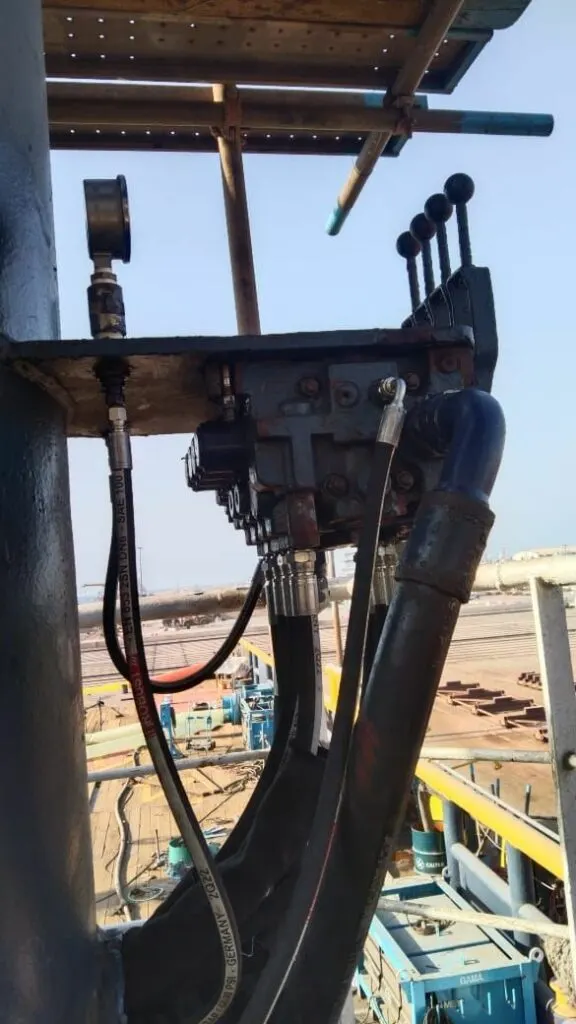
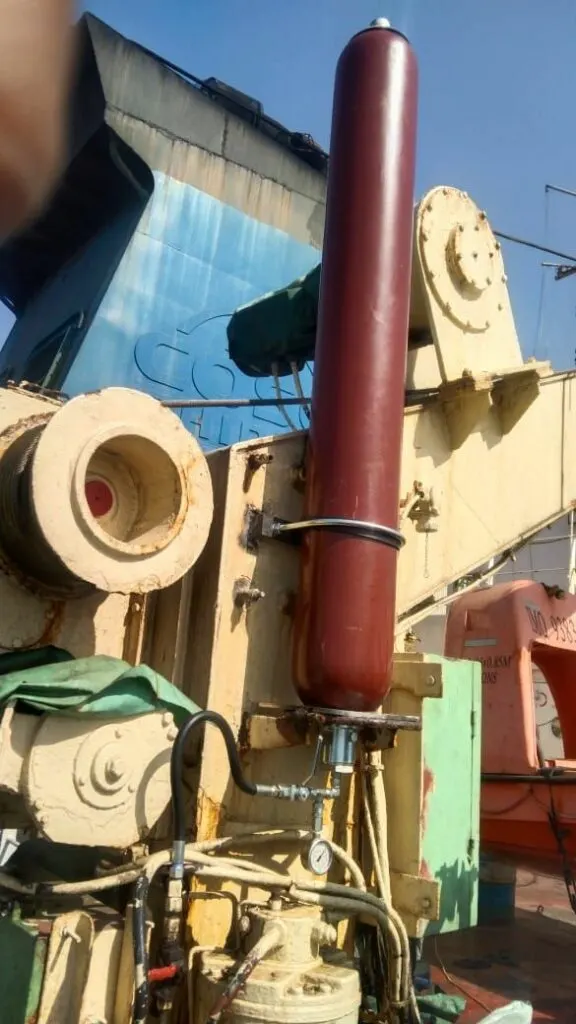
- Davit hydraulics checked: oil, leaks, accumulator pre-charge on davits with stored energy. See our accumulator guide.
- Fall wire certificates and spare falls ready if renewal is due.
Why five-yearly tests fail
- Brake slip or excessive stopping distance: contaminated brake linings, wrong adjustment, worn centrifugal brake
- Fall wire condition: corrosion, broken wires, or a fall older than five years
- Sheaves seized or worn, damaging the falls
- Hydraulic faults on davits with hydraulic luffing or slewing: leaking cylinders, accumulator pre-charge lost, valves sticking
- Release gear not resetting correctly, or wear beyond limits
- Structural corrosion at davit foundations and pins
Most of these are visible during a pre-inspection. We recommend one a week or two before the test date so parts can be ordered.
UAE conditions
- Salt and humidity attack falls, sheaves and pins on open decks. Fall wires in this climate often reach discard condition before five years.
- Heat dries out grease on sheaves and winch gears. Lubrication intervals matter.
- Anchorages at Fujairah and Khor Fakkan are common test locations. Allow for launch logistics and daylight.
- Davit hydraulic units on deck see high oil temperatures in summer. Seals and accumulators suffer.
Davit hydraulics
Many davits and rescue boat cranes have hydraulic luffing, slewing or stored-energy systems. Typical jobs we do alongside a five-yearly test:
- Davit cylinder reseal and bench test
- Accumulator nitrogen pre-charge check and bladder renewal
- Directional and solenoid valve overhaul
- Hose renewal on the davit hydraulic circuit
- Hydraulic hand pump overhaul
Doing these before the test removes the most common reasons for a failed or delayed test.
When to call us
Send the davit maker and model, boat type and mass with full complement, the date of the last five-yearly test, and the location. We plan the pre-inspection, any hydraulic repair and fall renewal, and the load test with water bags and certified load cells. Ask any service provider, including us, for the authorisation and personnel certification your flag requires. See our davit load testing service and check figures with the proof load calculator.