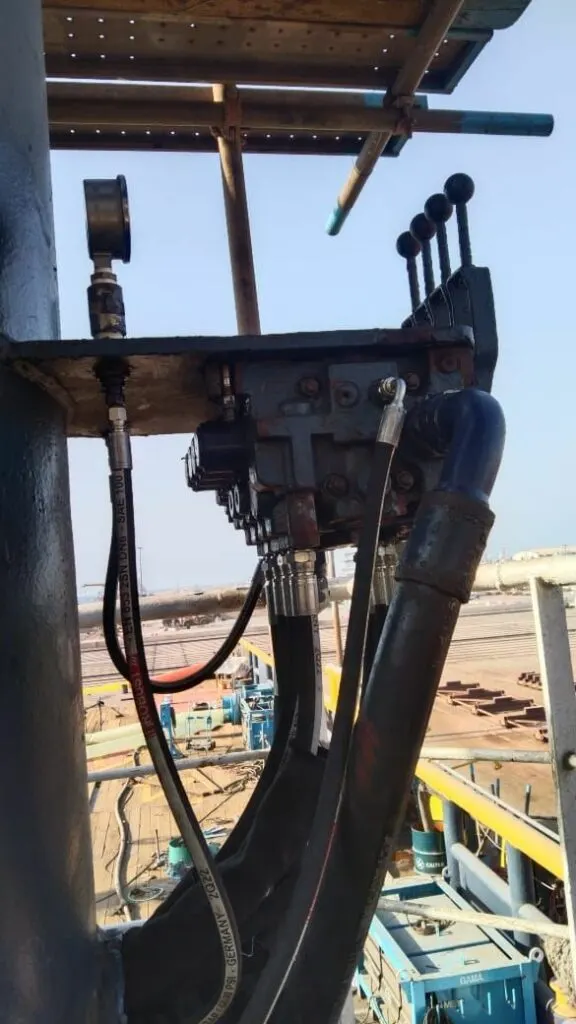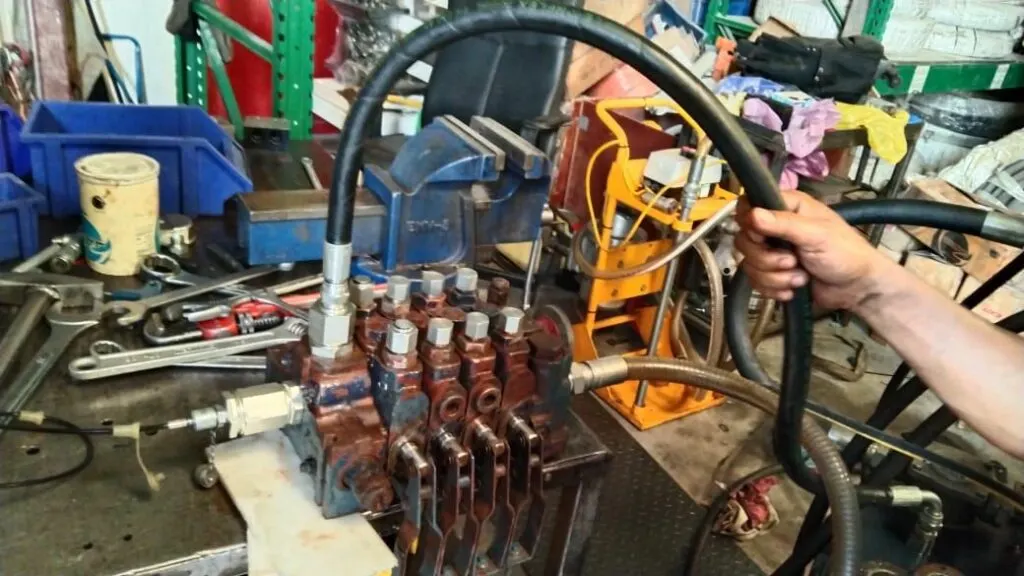
Replace a hydraulic hose immediately if it leaks, has exposed or damaged reinforcement, is kinked, crushed, blistered or has a fitting that has moved; otherwise replace it on a planned schedule based on age, duty and condition. Many marine and offshore operators renew hoses on critical equipment at around 5 to 6 years from manufacture, regardless of how they look, because hoses deteriorate from the inside before damage shows.
In the UAE, heat, sun and salt shorten hose life. A planned programme, where every hose is tagged, recorded and replaced on schedule, costs less than a crane or winch stopping with a burst hose.
Replace immediately if you see
- Any leak at the hose body or fitting, including weeping
- Cover worn through to the wire reinforcement
- Cracks in the cover, especially at bends, from heat or UV
- Blisters or soft spots: oil has got between layers
- Kinks, flattening or crushing
- Fitting slipped on the hose, or corroded so threads or crimps are weakened
- Hose twisted along its length (look at the layline)
- Signs of rubbing against steelwork or other hoses
- Hose stiff and hard compared with new hose of the same type, often a sign of heat ageing
Never search for leaks by hand. High-pressure oil can penetrate skin and cause serious injury. Use card or wood.
Age guidance
There is no single legal age limit for hydraulic hoses in general use. Guidance comes from the hose maker, the equipment maker, class or industry practice, and standards such as ISO/TR 17165-2, which gives recommended practices for hose assemblies, including inspection and replacement.
Practical guidance most operators use:
| Hose duty | Typical approach |
|---|---|
| Lifting appliances, davits, steering gear, towing equipment | Replace at around 5 to 6 years, or sooner on condition |
| General deck machinery and plant | Inspect at least yearly, replace on condition, review at 5 to 6 years |
| Hoses in high heat or heavy flexing | Shorter intervals based on inspection history |
| Stored spare hose assemblies | Check the manufacture date before fitting; old stock counts against service life |
Each hose has a date code on its layline or on a tag. Record it when the hose is fitted.
Hose types and ratings
Fitting the wrong hose type is a common cause of early failure. Typical maximum working pressures:
| Hose | Construction | Typical working pressure |
|---|---|---|
| SAE 100R1 / EN 853 1SN | One wire braid | About 225 bar (1/4”) down to about 90 bar (1”) |
| SAE 100R2 / EN 853 2SN | Two wire braids | About 400 bar (1/4”) down to about 165 bar (1”) |
| EN 856 4SP | Four spiral wires | About 280 to 450 bar depending on size |
| EN 856 4SH | Four or more heavy spiral wires | About 250 bar (2”) to 420 bar (3/4”) |
| SAE 100R13 | Multi-spiral | 350 bar (5,000 psi) in all sizes |
Always check the maker’s data sheet for the exact size and type. Standard hydraulic hoses have a minimum burst pressure of four times the working pressure.
Also check:
- Temperature rating. Many standard hoses are rated to around 100 °C continuous, some to 121 °C. Hoses near hot oil coolers or engines run close to that.
- Minimum bend radius. Bending tighter than the rating shortens life sharply.
- Pressure peaks. Systems with shock loads, such as cranes and winches, need hose rated above the relief setting with margin; spiral hoses handle impulse better than braided.
Our hose size tool helps choose the bore for a given flow and velocity.
Fittings matter as much as hose
- Use matched hose and fitting families from the same system. Mixing brands of hose and crimp fittings is a common cause of blow-offs.
- Crimp to the maker’s specification and check the crimp diameter.
- Choose the right end connection: JIC 37°, BSP, NPT, ORFS, metric DIN 24°, or SAE flanges. Mismatched threads leak.
- Use stainless steel fittings on deck where salt corrosion is severe.
Routing and installation
- Allow slack for movement and pressure change. A hose can shorten under pressure.
- Avoid twisting: keep the layline straight.
- Clamp hoses so they cannot rub. Use sleeves where they pass steelwork.
- Keep hoses away from hot surfaces and sharp edges.
- Use swivel or 90° fittings rather than forcing tight bends.
UAE factors
- Heat: oil temperatures in summer can approach the hose rating. Cover ageing speeds up with heat.
- UV: sun cracks hose covers on open decks, cranes and plant. Look at the sun-facing side.
- Salt: crimped ferrules and fittings rust, especially carbon steel. Corrosion at the crimp can let a hose blow off.
- Sand: abrasive dust wears covers where hoses move or rub.
Running a hose integrity programme
Replacing hoses one at a time when they burst costs more than a planned programme. A good programme has:
- Survey. Every hose on the machine or vessel is identified, measured and recorded: equipment, location, size, type, length, end fittings, pressure, date fitted.
- Tagging. Each hose gets a unique tag that links to the register.
- Risk ranking. Hoses on lifting, steering, towing and emergency systems get shorter intervals.
- Replacement schedule. Hoses are renewed by date and condition, in batches during planned stops.
- Records. Material certificates, pressure test records for new assemblies and a report showing what was replaced and when.
On a crane or winch, renewing all hoses at once during a planned stop is usually cheaper than replacing them one by one.
When to call us
We run whole-machine and whole-vessel re-hosing and hose integrity programmes: survey, tagging, workshop make-up and fitting with records. For one hose on its own, a local hose shop will be faster; we do not run mobile hose vans. See our hose management service and size hoses with the hose size tool.