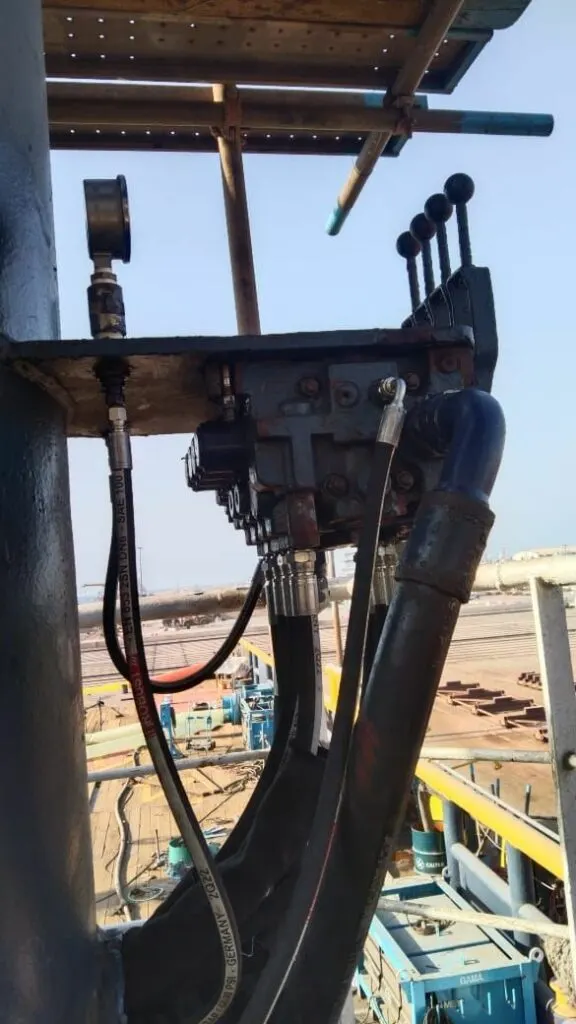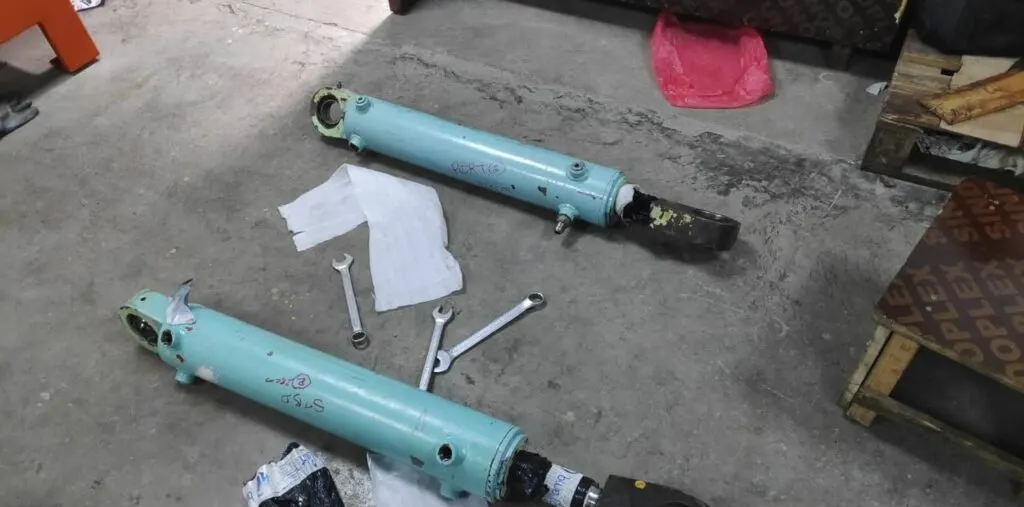
A hydraulic cylinder drifts when oil escapes from the side that holds the load, either across the piston seal, through a valve that should be holding it, or simply because the trapped oil cools and shrinks. The cylinder gets blamed first, but on cranes and davits the cause is often a counterbalance or pilot-operated check valve, so test before you strip anything.
Drift matters most on lifting appliances. A luffing cylinder that lets a boom settle under load, or a davit arm that creeps in, is a safety issue and will be noticed by any surveyor during a load test.
The four usual causes
| Cause | What happens | Typical clue |
|---|---|---|
| Piston seal bypass | Oil passes from the loaded side to the other side inside the cylinder | Drift continues with hoses capped at the cylinder |
| Load-holding valve leakage | Counterbalance or pilot-operated check valve does not seal | Drift stops when the cylinder ports are isolated |
| Directional valve spool leakage | Spool clearance lets oil pass to tank, mainly on valves without a holding valve | Drift varies with system pressure and oil temperature |
| Thermal contraction | Hot trapped oil cools and its volume drops | Slow, steady drift that stops once oil reaches ambient |
There are rarer causes: an external leak you have not seen, a cracked piston, a loose piston nut, or a pilot line holding a counterbalance valve partly open.
Step 1: Rule out thermal creep
Mineral hydraulic oil contracts by roughly 0.07% of its volume for every degree it cools. In a long cylinder, oil at 65 °C after a working shift that cools towards a 35 °C night can shrink by around 2%. With a long stroke that is enough to see the rod move.
Thermal drift is slow, steady and stops once the oil reaches ambient. If the drift is fast, carries on at constant temperature, or is worse when the oil is hot and thin, look further.
Step 2: Isolate the cylinder from its valves
This is the test that splits cylinder faults from valve faults.
- Lower or support the load safely. Never work under a load held only by hydraulics.
- With the cylinder supported, cap or plug both ports at the cylinder, or close isolating valves fitted at the cylinder.
- Raise the load to the test position again and remove the support only if it is safe to do so, or apply a known load by other means.
- Watch and measure the rod position over a set time, for example 10 minutes.
If the drift stops with the ports isolated, the cylinder is holding and the leak is in the valves or lines.
If the drift continues, oil is passing inside the cylinder: piston seal bypass, a damaged piston, or a loose piston nut. Plan a strip-down.
Step 3: Bypass test on the cylinder
For a double-acting cylinder you can measure bypass directly.
- Fully extend (or retract) the cylinder against its end stop.
- Disconnect the hose on the side that is not being pressurised and lead it into a measuring container. Keep it secure.
- Pressurise the other side to working pressure with the rod at the stop.
- Any flow from the open port is oil passing the piston seal.
A healthy piston seal should pass little or nothing. A steady stream means the seal is gone. Repeat at mid-stroke if possible by blocking the rod mechanically, because barrel scoring is often where the piston rests most.
Do this only with trained people, a known pressure source and the load removed. Oil injection injuries from leaking fittings are serious.
Step 4: Check the holding valves
If the cylinder held in Step 2, the counterbalance or pilot-operated check valve is the next suspect.
Counterbalance valves
- Check the setting. It is normally set above the maximum load-induced pressure, often around 1.3 times. Too low and the valve will crack open under load.
- Contamination on the seat is the most common fault. A particle on the poppet lets oil seep through.
- Check the pilot line. Back pressure in the pilot or a blocked drain on some designs can hold the valve partly open.
- Counterbalance cartridges are cheap compared with downtime. On older cranes we often replace rather than overhaul them.
Pilot-operated check valves
- Same seat contamination issue.
- Check the pilot line is vented to tank in neutral. A directional valve with a closed centre can trap pilot pressure and keep the check open.
Directional control valve
- On simple circuits without a holding valve, the spool is the only thing holding the load. Every spool valve leaks a little. Worn spools and bores leak more, especially with hot, thin oil.
Step 5: Look at the oil
Drift caused by valve seats almost always comes with dirty oil. Take a sample and get an ISO 4406 count. Counterbalance and proportional valves on cranes need oil around 18/16/13 or cleaner. Fixing the valve without cleaning the oil brings the fault back. See our guide to ISO 4406 oil cleanliness.
Fault-finding tree
- Drift stops when oil reaches ambient temperature → thermal contraction, usually no repair needed. Consider procedure changes, such as lowering loads at rest.
- Drift continues with cylinder ports isolated → piston seal bypass or internal cylinder damage → bypass test → strip, measure, reseal or repair.
- Drift stops with ports isolated → valve or line leak:
- Counterbalance or pilot-operated check fitted → check setting, pilot line and seat; clean or replace cartridge.
- No holding valve → DCV spool leakage → overhaul or fit a load-holding valve.
- Visible external leak on hose or fitting → renew.
- After any repair → check oil cleanliness and filter condition.
UAE factors
- Heat thins the oil. At 70 °C a VG 46 oil is a fraction of its viscosity at 40 °C, so every clearance leaks more. Drift that only shows in summer afternoons is a strong hint of worn spools or seals near their limit.
- Day-to-night temperature swings on deck make thermal drift more visible than in cooler climates.
- Dust contamination fouls valve seats. Breathers and tank seals matter.
Measuring drift for the record
Before and after any repair, record:
- Load on the hook or cylinder, or the boom position
- Oil temperature
- Rod position at start and after a fixed time, with a tape or dial gauge
- Which valves were closed or isolated
These numbers show whether the repair worked and are useful evidence if the appliance goes on to a load test.
When to call us
If you have done Step 2 and the cylinder drifts with its ports isolated, it needs a strip-down and bench test; our cylinder repair service covers that. If it holds, the valves are the problem, and our valve service can test and overhaul counterbalance and directional valves. Our cylinder force calculator helps you work out the pressure the load is putting on the holding valve.