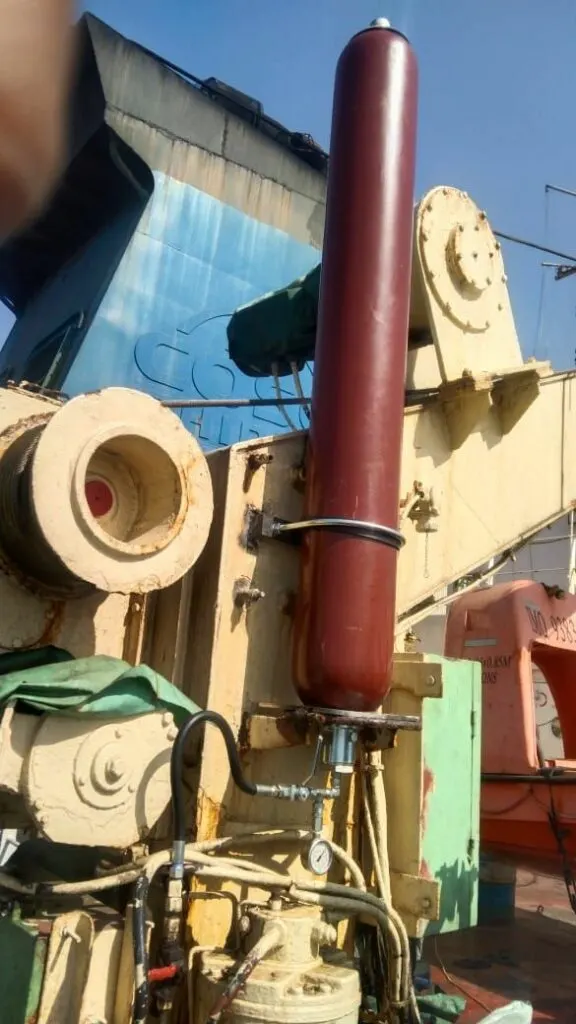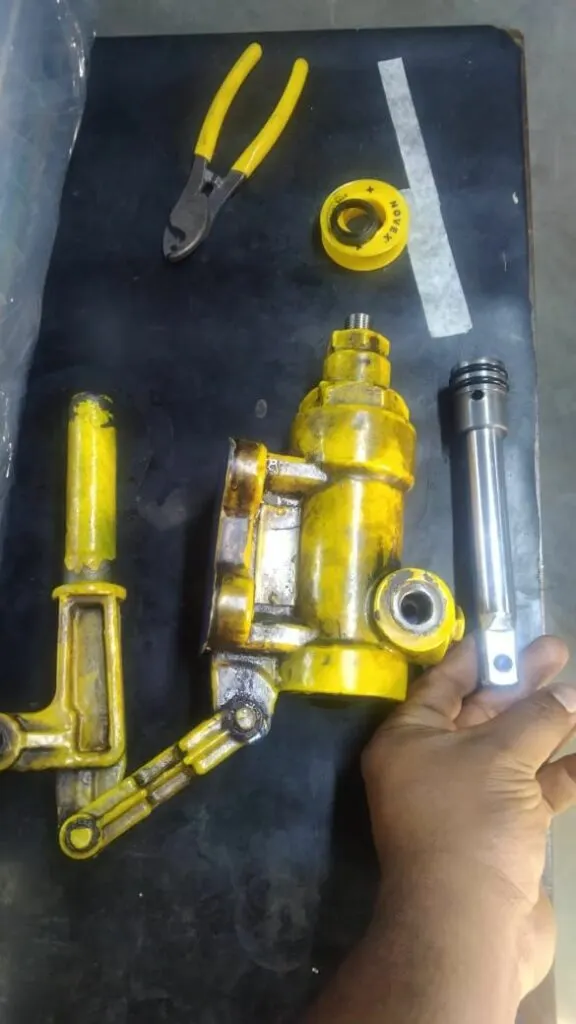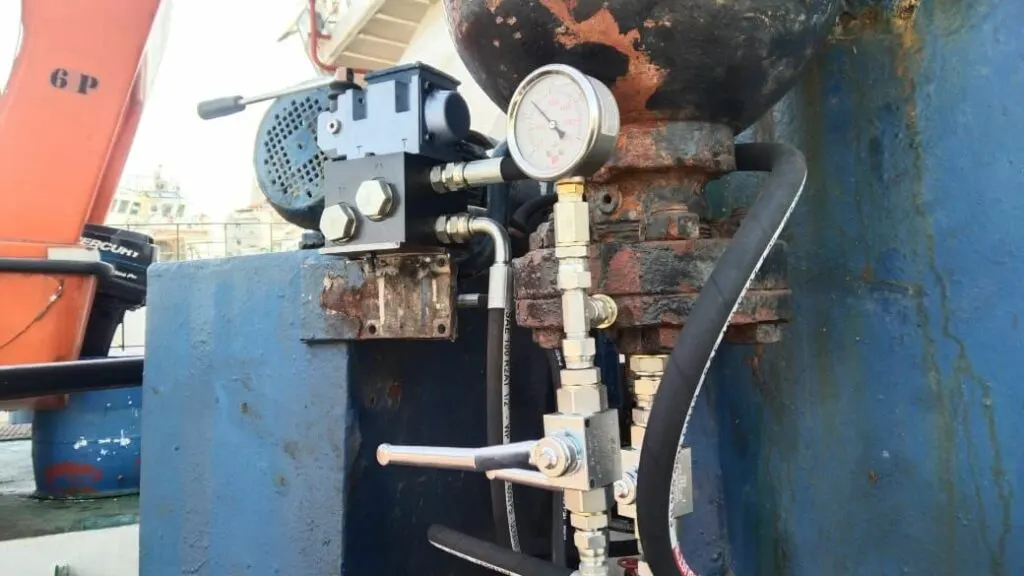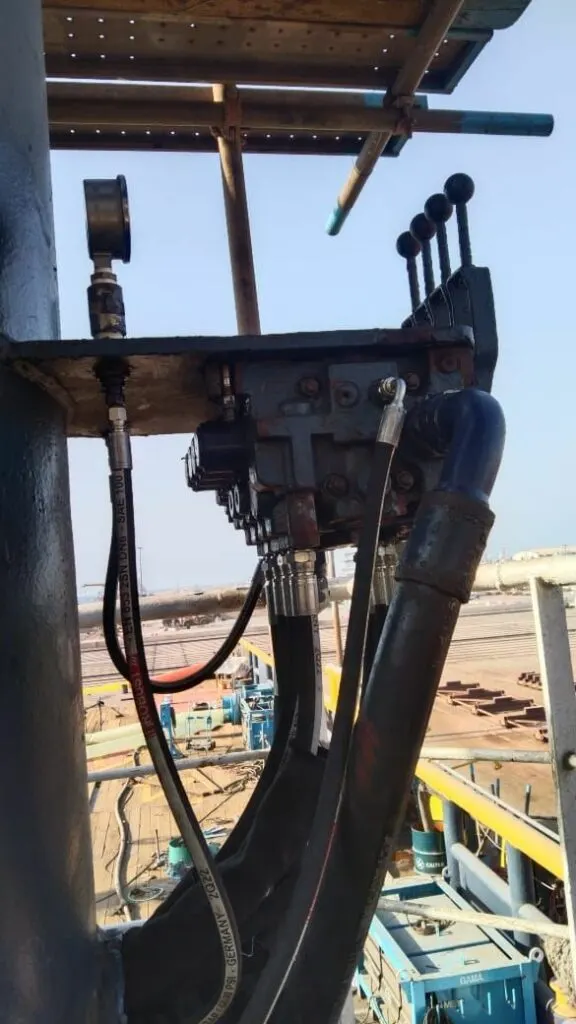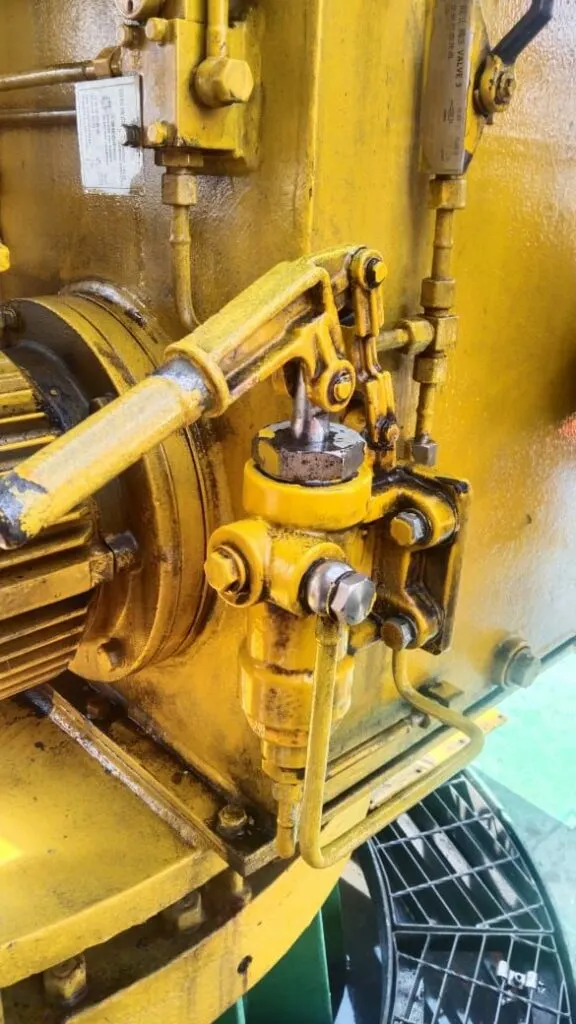
We repair hydraulic mooring winches, anchor windlasses, capstans, and towing and tugger winches: their motors, brakes, control valves, hoses and the power packs that drive them. The work is done on board in UAE ports and anchorages, in our Sharjah workshop for motors and valves, and as part of drydock packages.
How hydraulic deck machinery works
A hydraulic winch or windlass has three main parts:
- The drive. Either a low-speed, high-torque radial piston motor driving the drum directly, or a faster axial piston or orbital motor driving through a reduction gearbox.
- The brake. A band brake on the drum that holds the mooring line or anchor chain, usually applied by spring and released manually or hydraulically; plus, on many designs, a multi-disc brake on the motor shaft.
- The control. A control valve, often with counterbalance or brake valves, fed from a central hydraulic power pack or a dedicated pump unit.
Windlasses add a chain wheel (gypsy) and a clutch so the drum and chain wheel can be used independently. Towing and anchor handling winches on tugs and OSVs are larger and often have multiple drums and freefall functions.
Typical faults
- Slow hauling or loss of pull, from a worn motor (internal leakage), a worn pump on the power pack or a relief valve set low.
- Motor leaks at the shaft seal, often caused by high case pressure from a restricted drain.
- Creeping under load, where the brake valve or counterbalance valve leaks, or the brake does not hold.
- Brake problems: worn linings, seized linkages, incorrect adjustment, or hydraulic brake release cylinders leaking.
- Noisy motors or gearboxes, from bearing wear or contaminated oil.
- Overheating on long mooring operations in summer heat, especially with fouled coolers. See hydraulic overheating in UAE heat.
- Hose failures on deck, from sun, salt and chafing.
Brake tests and inspection pressure
The brakes on mooring winches are what hold the ship alongside. Tanker operators in particular follow industry mooring guidance that expects the brake holding capacity of each winch to be tested at regular intervals, typically yearly and after brake maintenance, and recorded. Windlass and anchoring equipment is examined at class surveys, and deck machinery leaks are an easy finding for port state control.
When the brake is tested, the hydraulic side must work too: the drum has to haul and hold, and the brake release has to work properly. We overhaul the hydraulics and work with the ship’s crew or the brake test provider to make sure the winch is ready. Our work is regularly witnessed by class surveyors from DNV, Bureau Veritas, Lloyd’s Register and ABS.
What we do
On-board troubleshooting. With pressure gauges at the motor and the valve, we find out whether the loss of pull is the motor, the valve or the supply. See engineer attendance.
Motor overhaul. Radial piston motors, axial piston motors and orbital motors are taken to our Sharjah workshop, stripped, inspected and repaired with genuine or equivalent parts, then tested. Brands we see include Hydac, Staffa, Brevini, Bosch Rexroth, Parker/Denison and Danfoss. See pumps and motors and the brand pages for Danfoss and Parker and Denison.
Valve overhaul. Control, counterbalance and brake valves are overhauled and bench tested. See valves and VRCS.
Brake release cylinders and band brake hydraulics are resealed and tested.
Power pack work. Pump overhaul, cooler cleaning, accumulator checks, oil change and filtration. See hydraulic power units.
Re-hosing. Mooring deck hoses replaced as a set from a survey, made up in our workshop. See hose management.
Drydock packages. Full overhaul of winches and windlasses as part of a docking. See deck machinery and winches.
Repair or replace the motor
Large radial piston and axial piston winch motors are almost always worth repairing: the housings are robust and the wear parts are replaceable. Small orbital motors on light capstans can be cheaper to replace than repair. We tell you which after inspection, with a quote for each.
What to send for a quote
- Vessel name, port or anchorage, ETA and how long the ship stays.
- Winch or windlass maker and type, and how many units are affected.
- The motor nameplate (maker, model, displacement) with a photograph.
- The fault: slow, leaking, noisy, creeping, not holding.
- The date of the last brake test, if a test is coming up.
We usually quote within one working day of receiving photos and nameplate data. We focus on overhauls, load tests and planned work rather than single-hose call-outs; for one hose, a local hose shop will be quicker.