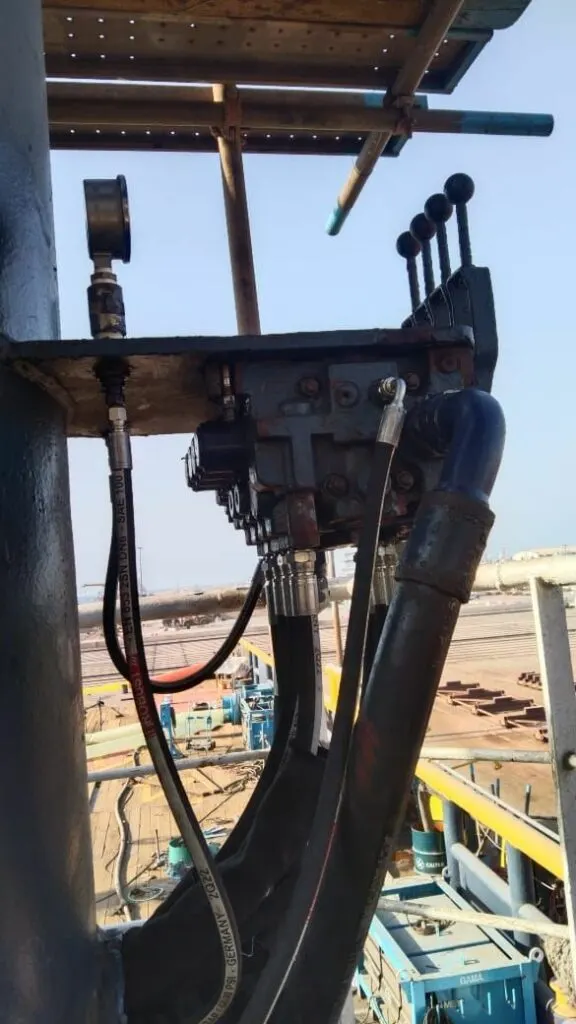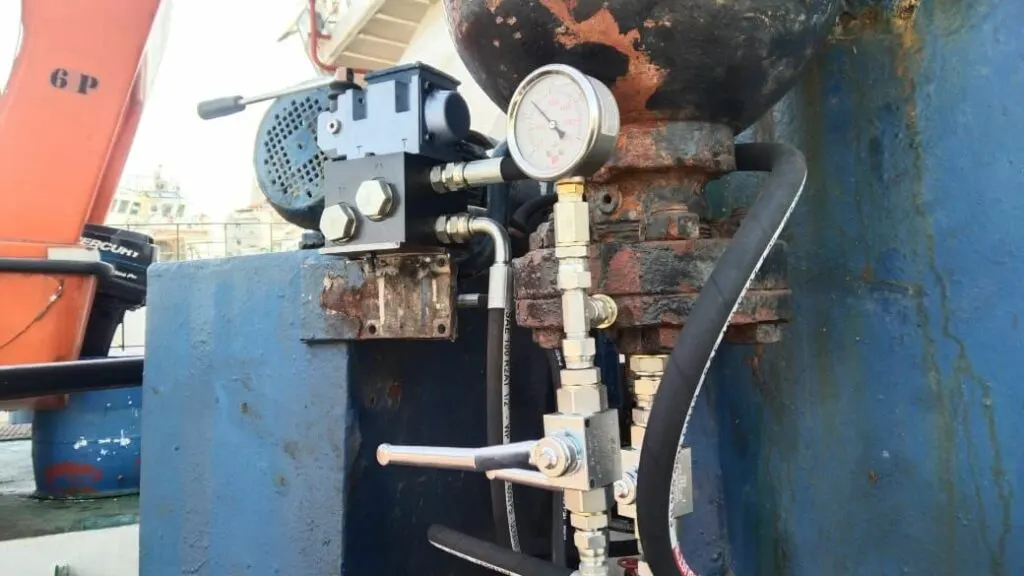
SOLAS requires that a ship’s main steering gear can put the rudder from 35° on one side to 30° on the other in no more than 28 seconds at the deepest seagoing draught and full ahead service speed, and that the steering gear is checked and tested within 12 hours before departure. Emergency steering drills are required at least every three months. Most failures in these tests trace back to hydraulic wear, air in the system or control faults, all of which can be found and fixed before the surveyor attends.
This guide covers what the rules ask for, how the tests run on board, and the hydraulic faults we see most often on steering gear in UAE waters.
What the rules require
The design and performance requirements are in SOLAS chapter II-1, regulation 29. The operational checks and drills are in chapter V, regulation 26. Your class society’s rules and the steering gear maker’s manual add detail.
Performance
| Gear | Requirement |
|---|---|
| Main steering gear | 35° one side to 30° other side in not more than 28 s, at deepest seagoing draught and maximum ahead service speed |
| Auxiliary steering gear | 15° one side to 15° other side in not more than 60 s, at deepest seagoing draught and half of maximum ahead service speed or 7 knots, whichever is greater |
At sea trials or when the ship cannot be loaded to the deepest draught, class accepts tests at other conditions with calculation or other evidence. Check with your surveyor what will be accepted.
Pre-departure checks (within 12 hours before departure)
- Full movement of the rudder according to the required capabilities
- Main and auxiliary steering gear
- Remote control systems and steering positions on the bridge
- Emergency power supply
- Rudder angle indicators against the actual rudder position
- Remote control system power failure alarms
- Steering gear power unit failure alarms
- Automatic isolating arrangements and other automatic equipment
Drills
- Emergency steering drills at least once every three months, including direct control from the steering gear compartment and the communication procedure with the bridge.
How a timing test runs
- Confirm both power units start and run, and that alarms are live.
- With one pump running, put the helm hard over to 35° on one side.
- Start the clock and put the helm to 30° on the other side. Stop the clock when the rudder reaches 30°.
- Repeat in the other direction.
- Repeat with the other pump, and with both pumps if the design allows.
- Record oil temperature, system pressure and times.
Do a trial run alongside before the surveyor attends. If the times are near 28 seconds in harbour with no load, they will be worse at sea.
Hydraulic faults that fail steering tests
Slow rudder movement
- Worn pump: internal leakage means less flow reaches the rams or vanes. Check case drain flow on piston pumps and compare with the maker’s limit.
- Relief or safety valve passing at a lower pressure than set.
- Internal leakage in the actuator: ram seals on ram-type gear, vane seals on rotary vane gear.
- Wrong or worn oil: too thin when hot. Steering gear compartments in the Gulf can reach very high temperatures in summer.
Rudder hunting or creeping off course
- Leaking hydraulic locking valves or a worn directional valve.
- Air in the system: spongy, irregular movement, noise.
- Control faults: feedback linkages, solenoids, proportional valve amplifiers.
Uneven times port and starboard
- Unequal leakage in one ram pair or one side of a rotary vane.
- A sticking spool or solenoid in one direction.
Noisy pumps
- Cavitation from a blocked suction strainer or low oil level. See our noisy pump guide.
External leaks
- Ram gland seals, hoses and flange O-rings. A leaking ram gland on a two-ram gear is the most common job we see.
Checks before the survey
Work through this list a week before:
- Oil level in tanks and expansion tanks, and oil condition. Take a sample and get an ISO 4406 count and water content.
- Filter condition indicators. Change elements if in doubt.
- Ram glands and pipe joints for leaks. Wipe clean and recheck after running.
- Hoses: age, cracking, chafe. Steering gear hoses are high-consequence; see when to replace hydraulic hoses.
- Run each pump and listen. Note pressures in steady state and at hard over.
- Rudder angle indicators against the mechanical pointer at the tiller.
- Alarms: simulate power failure and low oil level.
- Emergency steering: verify the change-over procedure and communication with the bridge work in practice.
- Accumulators on control circuits, if fitted: check pre-charge. See our accumulator guide.
- Air bleed points: bleed if the gear has been opened.
Annual service scope
A typical annual steering gear service we carry out covers:
- Oil sample and analysis, filter change
- Inspection of rams or vane unit for leakage and wear
- Pump running checks; overhaul if case drain or pressure figures are poor
- Directional, relief and locking valve checks
- Hose and pipe inspection, renewal as needed
- Timing test with the crew and a report with the recorded figures
Where class asks for it, the test can be witnessed by the class surveyor.
Seal renewal on rams
Ram-type steering gear usually needs gland seal renewal sooner or later. The work depends on the design:
- Some glands can be resealed with the ram in place, after supporting the rudder and isolating the cylinder.
- Others need the ram withdrawn. This is a bigger job that needs lifting gear in a tight compartment.
In both cases the rod surface must be checked. A pitted ram cuts new seals quickly. We measure the ram and report before fitting new seals.
UAE factors
- Heat: steering gear compartments sit near the stern and can be very hot in summer. High oil temperature thins the oil and ages seals. Check ventilation and any oil cooler.
- Idle periods at anchorage: vessels waiting off Fujairah or Khor Fakkan for weeks may have gear that has not moved under load. Run it fully before departure.
- Humidity: water condenses in tanks. Check water content in the oil sample.
When to call us
If timing tests are marginal, a pump is noisy, or a ram gland is leaking, send the steering gear make and model, recent test times and photos. Our steering gear service covers annual service, seal renewal, pump and valve overhaul and test support. Use the pump power calculator to sanity-check motor and pump figures against the gear’s pressure and flow.