Most leaking or drifting hydraulic cylinders should be repaired, not replaced: a reseal with a measured inspection costs a fraction of a new cylinder and is usually back in service within a week. Replacement makes sense when the barrel is out of tolerance, the rod is bent or pitted beyond re-chroming, the cylinder is obsolete, or the downtime of a rebuild costs more than buying new.
The decision should come from measurements taken after strip-down, not from how the cylinder looks on deck. A badly rusted rod can clean up well; a cylinder that looks fine can have a barrel scored deep enough to make a reseal pointless.
Start with the symptom
The symptom tells you which part to suspect before anything is opened.
| Symptom | Most likely cause | Usual outcome |
|---|---|---|
| Oil weeping at the gland, rod wet | Rod seal or wiper worn, light rod damage | Reseal, polish rod |
| Oil running down the rod in drops | Rod seal failed, rod scored or pitted | Reseal, rod re-chrome or new rod |
| Load creeps down with valves closed | Piston seal bypass, or a valve leaking | Bypass test first, then reseal (see drift causes) |
| Jerky movement, chatter | Air in the cylinder, worn guide bands, counterbalance setting | Bleed, guide band renewal, valve check |
| Visible bend or rod rubbing the gland | Side load, impact | Rod straighten or new rod |
| Cracked eye, clevis or trunnion weld | Fatigue or overload | Weld repair with NDT, or new end |
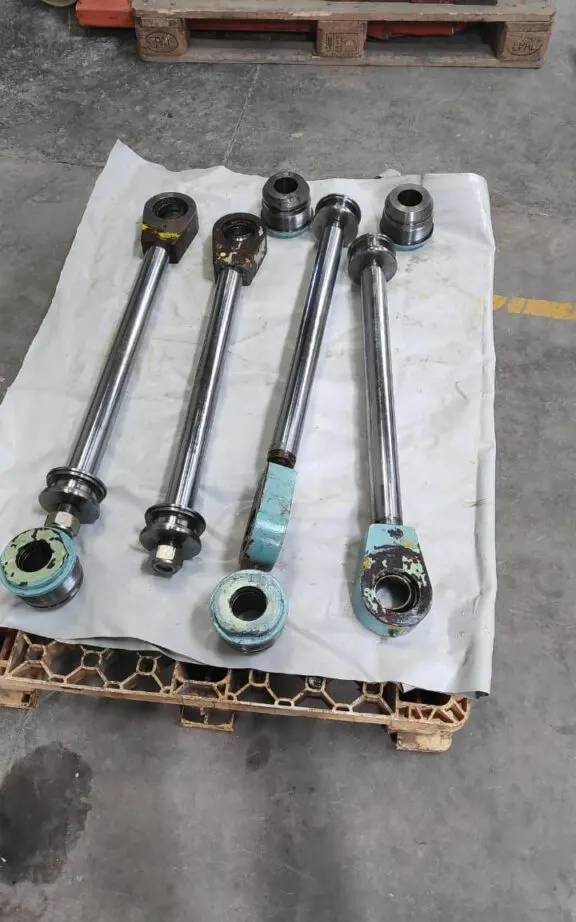
What we measure after strip-down
A proper decision needs numbers. These are the checks on every cylinder we strip.
Rod
- Diameter at several points along the stroke, compared with nominal. Rods are usually ground to an f7 or f8 fit.
- Chrome condition: pitting, flaking, scoring. A score you can catch with a fingernail will cut a new seal within weeks.
- Straightness on rollers with a dial gauge. Even a small bend loads one side of the gland and the piston.
- Corrosion under the chrome near the eye end, common on deck cylinders in salt air.
Barrel (tube)
- Bore diameter and ovality at both ends and the middle. Honed tubes are typically made to H8 or H9 tolerance.
- Scoring along the piston travel, especially where the piston rests most of the time.
- Bulging near ports or at the end that sees pressure peaks.
Gland, piston and seals
- Gland bore wear and guide band seats.
- Piston seal grooves, damage from debris, and the piston-to-rod fixing (nut, thread, locking).
- Seal condition: extrusion, hardening, nibbling. Hard, cracked seals in the UAE often point to oil running too hot (see overheating).
Structure
- Eye ends, clevis, trunnions and spherical bearings. Worn bearings let the cylinder side-load itself.
- Welds on mounts. On lifting appliances, any weld repair is followed by crack detection.
Repair options, from cheapest to most involved
- Reseal only. New seal kit, clean, reassemble, bench test. Right when the rod and barrel are within tolerance. Typically 3 to 7 working days after strip-down.
- Reseal and rod polish. Light marks polished out within the chrome.
- Rod re-chrome. The rod is ground undersize, hard-chrome plated and ground back to size. Adds time; done by our machining partners.
- New rod. Made from induction-hardened chrome bar to the original drawing or sample. Often quicker than re-chroming a long rod.
- Barrel re-hone. Removes light scoring. The bore grows slightly, so the seal kit may need to suit the new size.
- New barrel or gland. Machined to sample when the tube is too far gone.
- New-build cylinder to sample. Bore, rod, stroke, mounts and ports copied from the old unit and rated to the system pressure.
- New OEM cylinder. Matching part number from the equipment maker.
When replacement wins
Replace rather than repair when:
- The barrel is out of round or scored deeper than a re-hone can remove without going oversize beyond available seals.
- More than two major parts (rod, barrel, gland, piston) need replacing. At that point you are paying for most of a new cylinder plus labour.
- The cylinder has failed the same way more than once and the root cause is design or duty, not wear.
- It is obsolete and seal kits cannot be sourced.
- The OEM unit is in stock locally and the equipment downtime costs more per day than the difference between the options.
Remember lead times. A new OEM cylinder for a marine crane or davit can take many weeks to arrive in the UAE. A rebuild or a new-build to sample is often faster.
A quick cost comparison
Use this as a starting point for your own numbers.
| Option | Relative cost | Typical time |
|---|---|---|
| Reseal and bench test | Lowest | 3 to 7 working days after strip-down |
| Reseal plus new rod | Medium | Add the rod manufacturing time |
| Reseal plus re-chrome and re-hone | Medium to high | Longer, depends on the partner queue |
| New-build to sample | High | Depends on size and materials |
| New OEM cylinder | Highest | Depends on the maker; often weeks |
Remove-and-refit labour, scaffolding, crane hire for large cylinders and transport are separate costs that apply to every option. For more on what drives the cost, see what drives hydraulic repair costs in the UAE.
Check the size before you commit
Before buying a replacement, confirm the cylinder can still do the job. Force is pressure times area:
- Piston area A = π × D² ÷ 4
- Push force (kN) = pressure (bar) × area (cm²) ÷ 100
A 100 mm bore at 200 bar gives 78.5 cm² × 200 ÷ 100 = about 157 kN. On the rod side, subtract the rod area. Our cylinder force calculator does this for both sides.
UAE conditions that shorten cylinder life
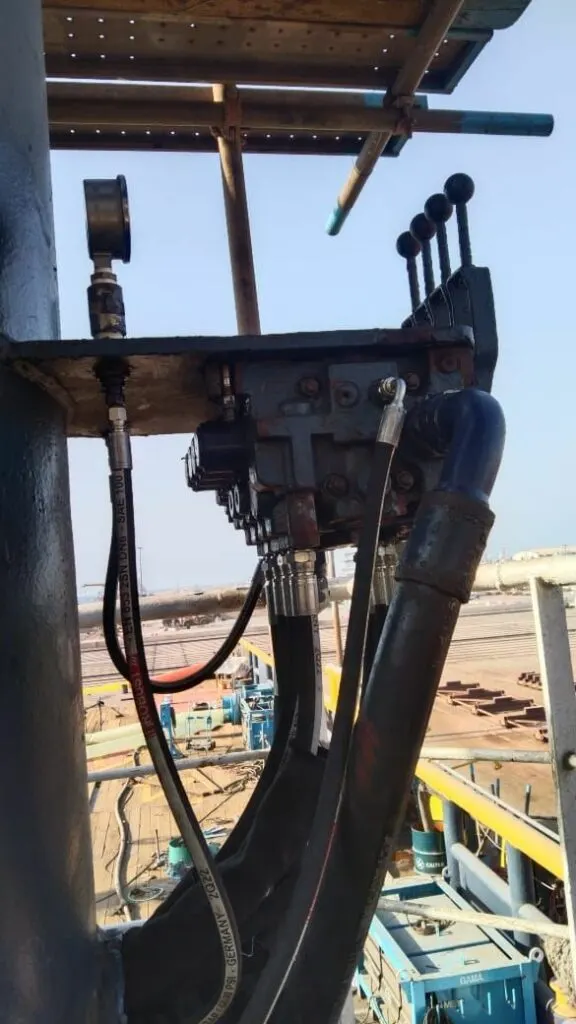
- Salt and humidity attack exposed chrome on deck. Rods left extended for weeks corrode first. Retract them where possible.
- Dust and sand get past worn wipers and score rods and seals. A cheap wiper renewal protects an expensive rod.
- Heat above 60 °C oil temperature hardens nitrile seals. Systems that run hot in summer show more rod seal leaks by autumn.
- Long idle periods on laid-up vessels and plant let seals take a set and rods corrode in one spot.
The bench test
Every repaired cylinder should be tested before refitting. We pressure test on the bench at 1.5 times working pressure, hold, and check for external leakage at the gland and ports and for internal bypass across the piston. The test report records the pressure, hold time and result. It is the document your surveyor or insurer will ask for.
When to call us
If a cylinder is leaking, drifting or damaged, send photos, the nameplate and the bore × rod × stroke if you know it. We will tell you whether a reseal is likely enough and what it may cost if parts are worn. See our hydraulic cylinder repair service and check sizes with the cylinder force calculator.