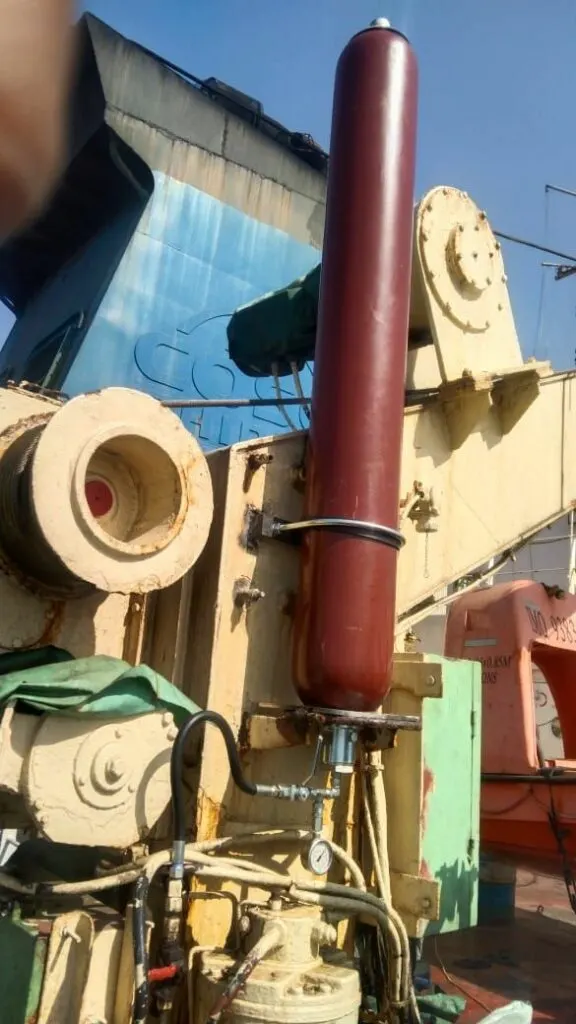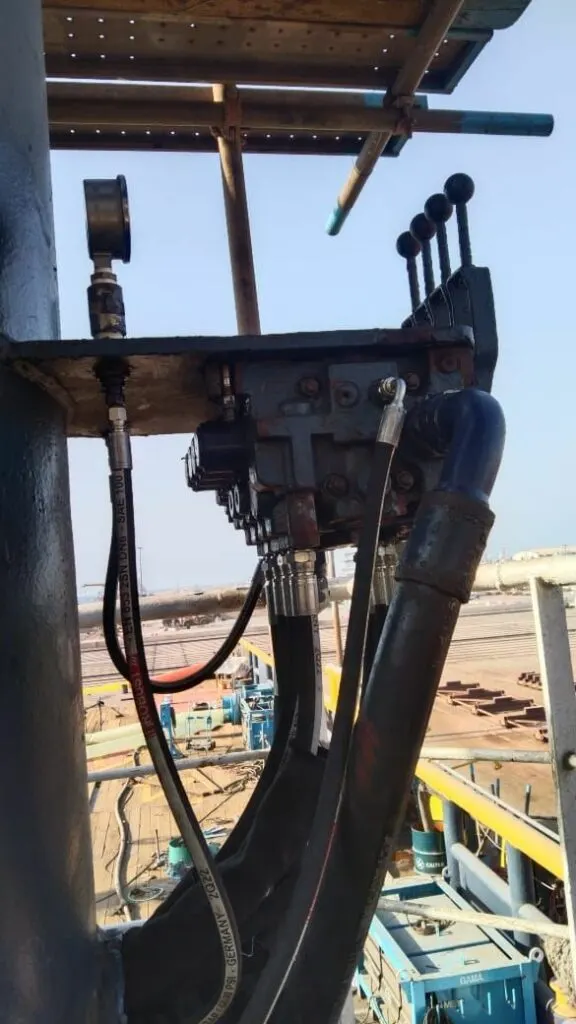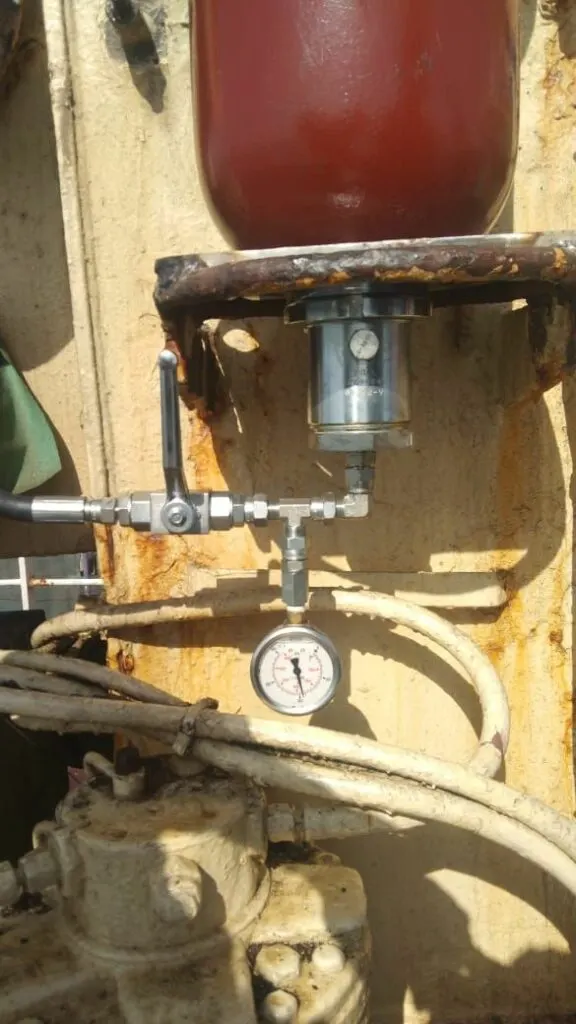
For energy storage, a hydraulic accumulator’s nitrogen pre-charge is typically set to about 90% of the system’s minimum working pressure, checked with the oil side fully depressurised, and corrected for temperature. A pre-charge that is too low or lost entirely means the accumulator stores little or no usable oil, which is why emergency functions on davits, towing pins, watertight doors and cranes fail when they are needed.
Accumulators also store a lot of energy even when the pump is off. Always treat them as live until both the oil and gas sides are proven safe.
What the pre-charge does
A bladder, piston or diaphragm accumulator separates nitrogen from oil. When system pressure rises above the pre-charge, oil enters and compresses the gas. When pressure falls, the gas pushes the oil back out.
The useful oil volume depends on three pressures:
- P0: pre-charge (gas only, oil side at zero)
- P1: minimum working pressure the system needs
- P2: maximum working pressure
Too low a pre-charge and the gas is already squeezed small at P1, so little oil is delivered between P2 and P1. Too high (above P1) and the accumulator empties before the system reaches its minimum pressure, and on bladder types the bladder can be forced into the oil valve.
Typical pre-charge settings
| Application | Typical P0 |
|---|---|
| Energy storage (emergency functions, stored power) | About 0.9 × P1 |
| Shock absorption | About 0.6 to 0.9 × the working pressure, per maker’s guidance |
| Pulsation dampening | About 0.6 to 0.75 × the mean working pressure |
| Thermal expansion compensation | Close to the system pressure at rest, per maker’s guidance |
Bladder accumulators are usually limited to a maximum P2:P0 ratio of about 4:1. Check the maker’s data for the model.
Sizing in brief
For energy storage with isothermal (slow) conditions:
Usable volume ΔV = V0 × (P0 ÷ P1 − P0 ÷ P2)
using absolute pressures (bar gauge + 1). For fast discharge, adiabatic conditions apply and usable volume is lower. Our accumulator calculator works through both.
Example: a 50 litre accumulator, P0 = 90 bar, P1 = 100 bar, P2 = 200 bar. Absolute: 91, 101, 201. ΔV = 50 × (91/101 − 91/201) = 50 × (0.901 − 0.453) ≈ 22 litres (isothermal).
Temperature correction: important in the UAE
Nitrogen pressure rises and falls with temperature. A pre-charge set at 20 °C reads higher at 45 °C on deck.
P0 at temperature T = P0 at 20 °C × (T + 273) ÷ (20 + 273), using absolute pressures.
Example: 90 bar gauge (91 bar absolute) set at 20 °C reads about 91 × 318 ÷ 293 − 1 ≈ 98 bar gauge at 45 °C.
So:
- Check pre-charge with the accumulator at a known temperature, and record it.
- Do not “top up” a hot accumulator to the cold figure; it will be under-charged when it cools.
- Accumulators in direct sun on deck can be much hotter than air temperature.
How to check pre-charge safely
- Isolate the system and stop the pump. Lock out.
- Discharge the oil side fully to tank through the accumulator’s dump or bleed valve. Confirm zero pressure on a gauge on the oil side. Do not rely on the main system gauge alone.
- Fit a charging and gauging assembly to the gas valve. Use the correct adaptor for the valve type.
- Read the pre-charge. Note the temperature.
- Adjust if needed using dry nitrogen only, from a regulated cylinder with a pressure reducer. Never use oxygen, compressed air or any other gas: oxygen or air with oil can explode.
- Remove the gauging assembly, check the gas valve for leaks, fit the cap.
- Return to service and record P0, temperature and date.
Signs of a failed bladder or lost pre-charge
- Pre-charge reads zero or much lower than set
- Oil comes out of the gas valve when checked: the bladder has failed
- System pressure drops quickly when the pump stops; the pump cycles on and off rapidly
- Emergency function does not complete its stroke on stored energy
- Hammering or shock in the system that used to be smooth
Bladders age, especially with heat. A bladder that loses pre-charge repeatedly needs replacing. On older units, check the shell for corrosion and the date of the last inspection.
How often to check
- Critical emergency functions (davits, towing pins and shark jaws, watertight doors, steering gear control): check at least at every scheduled service, and before tests or class surveys.
- General systems: every 6 to 12 months, or as the maker recommends.
- After any work on the hydraulic system or a long idle period.
Keep a log of pre-charge readings with temperature. A slow downward trend shows gas loss before the function fails.
Safety rules
- Accumulators are pressure vessels. Do not weld, drill or heat them.
- Never remove an accumulator or loosen fittings until both oil and gas sides are confirmed at a safe state.
- Use only the maker’s charging equipment and dry nitrogen.
- Gas valves and caps are not handles.
- Mark accumulators with their pre-charge and date.
- Follow the maker’s procedure and any national pressure equipment rules for inspection and disposal.
UAE conditions
- Heat raises pre-charge on hot days and ages bladders. Set and record at a known temperature.
- Salt corrodes shells, valve caps and mounting clamps on deck. Check and protect.
- Long idle periods at anchorage let small leaks drain pre-charge unnoticed. Check before use.
When to call us
We check and recharge accumulators, replace bladders, and supply new accumulators, often as part of power pack, davit, towing system or watertight door work. Send the make, volume, maximum pressure and what it serves. See our power pack service and size or check an accumulator with the accumulator calculator.